Showing posts with label CEO. Show all posts

Wednesday, January 23, 2013

Koch and Empire Grew Together (1994 Wichita Eagle Article)

Source: Wichita Eagle 

This past week I stumbled upon a really good article from June 26-27, 1994 about Charles Koch and Koch Industries. The article has some articles I referenced in my three part series (part 1, part 2, part 3) on the Koch brothers. However, the first article was more of a profile of Charles Koch. Bob Cox did a profile of Charles and his family in 1998 for the Wichita Eagle did a profile. The Wichita Eagle recently did a profile in 2012 by Roy Wenzl .

One thing I learned from the 1994 article was how much Charles Koch loves to read. According to the article at least in the 1990’s he spent at least 2 hours every day reading. He reads scholarly books on economics, history, philosophy, and psychology. He even read the Old Testament of the Bible just because he was curious. This is interesting because when Charles was younger he was more interested in parties and playing rugby and actually was expelled in high school for drinking. Koch thought about being a mathematician  scientist, or economist (thank goodness he didn't pick those). An interesting fact is he graduated M.I.T with 2 graduate degrees (chemical engineering and nuclear engineering) by the time he was 24. After all this he considered going to Harvard Business School. William Koch did take some business courses at MIT according to this.

Once Charles started working at Koch Industries he was working 7 days a week. He tended to look at problems as an engineer instead of understanding the importance of people. Everything I have read indicates that he is a workaholic which actually isn't bad as a side effect is becoming a billionaire. Charles didn't seem to understand that people had a life outside work, however Charles' life was work. One meeting in August of 1968 started at 4 P.M. and lasted until midnight. Executives were expected to work on Saturday.

Koch has an interesting management style. Up until this point I have never read anything about how he managed people. Even Charles Koch himself acknowledges that he doesn't try to be a tough boss however he may be insensitive from time to time.People say that while Koch is demanding he is also very fair and doesn't like people who lie. He has a great analytical mind (makes sense he is an engineer), sharp, and seems to know what questions to ask. Koch will actually let employees make the decision at the end of the day (this is part of market based management). One interesting quote from Koch about work is that "True self-respect only comes from real accomplishment, because you can't kid yourself for very long". Another good quote Koch has that could be applied to management is "If you have a proposition or thesis or theory, you're obligated to search just as hard for facts that disprove it as you do for facts that support it".

The relationship between Charles and Liz Koch is interesting too. Apparently the folk tale is that Charles was so busy he had to propose to Liz over the phone. Apparently when they first met Charles was not with the times as he was reading books in economics, philosophy, psychology, and history. There was a charm about Charles that was attractive to Liz however. After 5 years of dating Charles and Liz were married in 1972. What is interesting is that in the 1990's when this story was done the family had no servants or help despite being worth $1-$2 billion (according to my Koch historical net worth page)

Koch also doesn’t like to waste any time. He really uses every minute to add value or learn something. He only lives 15 minutes away from work and listens to books on tape (Dr. Walter E. Williams of George Mason University also does this listening to tapes from Academic Plant). In a 3 week trip to Orient that Koch had planned he didn't spend one minute relaxing. When the Koch family went on a trip to the Summer Olympics in Spain Charles wanted to see 4-5 events a day which wore every one out (kids swore it would be the last trip they would go on). Even on a Sunday afternoon Koch will be watching football games with his work papers out doing both things at the same time.

Charles isn't much of a partier (nor does he need to be running a multi-billion dollar company). David is more outgoing like mother Mary Koch use to hold (don't know if he still does) a New Year's Eve party that held 800 people as of 1993 in Aspen, CO. Even Newsweek said it was a great party to crash. Charles doesn't like to party but he does enjoy good wine.

What is really interesting is how in 1966 Koch Industries had $177 million revenue and in 2012 the company had $110 billion in revenue. This is an annual growth rate in revenue of 15% which is pretty amazing. One reason might be of Market Based Management. Personally I don’t think Charles Koch works for money as so many of the left claim. His house seems quite modest for his net worth. He does have homes in California and Aspen however even though they are only worth a few million dollars each it is very small compared to his net worth of around $31 billion. They didn’t even have servants in the 1990’s despite being worth in the billions. The Koch family does have expensive cars and charter company planes for trips however they are not socialites who party all the time and have fun. They say he is greedy and trying to control democracy by buying politicians. To me Charles Koch preaches about free markets and liberty. Liberals forget that means personal liberty which is for social liberty (legalize drugs, same-sex marriage, etc). People forget this and just label Charles and David Koch as Republicans but they really do have certain libertarian ideas.

Personally I am glad I found this classic article from 1994. It revealed to me that Charles Koch doesn't like wasting time, challenges himself on a daily basis, works his tail off, and really seems like a decent human being. Now if we can just get others to realize his enormous accomplishments we all might be better off. I personally do hope all the Koch brothers publish their own autobiographies so they can tell their own stories in stead of having other people tell it for them. 

Monday, December 10, 2012

John Allison on Financial Crisis and Market Purity


John Allison recently spoke to AEI on December 6, 2012. I have a lot of respect for John Allison who actually was a CEO of a bank during the financial crisis which gives him more credibility to discuss the topic rather than someone who believes what should have happened. Allison did a great interview for the Kaizen where he discussed his career at BB&T and explains how he grew the company. Dr. Walter E. Williams also wrote a column about the recent book John Allison published called "The Financial Crisis and the Free Market Cure . I read the book myself and really had no idea how much the banking industry was regulated or how government policies really were one of the main causes of the financial crisis in 2008. Allison was not to long ago was named the President and CEO of the CATO Institute. Cheers for Mr. Allison and bringing some sanity in a world of insanity!

Thursday, June 21, 2012

Tuesday, May 22, 2012

CEO Compensation in Options 1965-2011


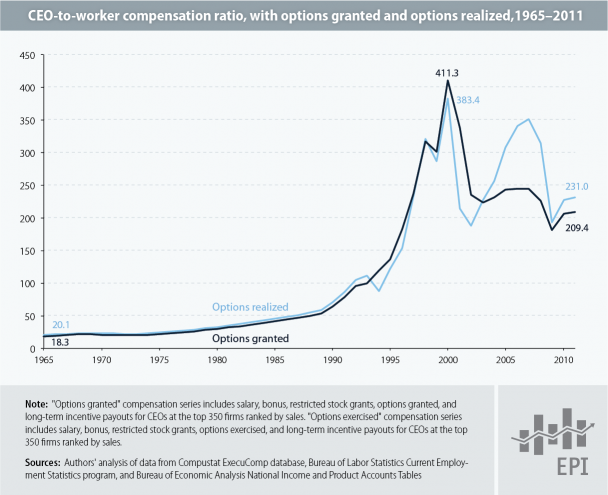
The following chart shows the relationship between CEO-worker compensation in the form of options (H/T Greg Mankiw). Usually executives and sometimes employees are granted stock options so the company can tie performance to how well the company is doing. The idea is that if that people are given stock options they will want to work hard to increase the value of the company thereby increasing their own compensation.

Options are granted by the company to the employee. However, the employee must wait a period of time before they can actually exercise or have the right to buy the options. I have a feeling many people think executives can just cash out there options whenever they want however the board of directors and shareholders are not stupid. The employee has to wait until the vesting period is over. The vesting period is the amount of time the employee has to wait before he or she sells their options. Typically the average amount of time is between 4-5 years. So really management or employees can’t have a short term view since they can’t even cash out their options until the 4 or 5 year period is over.

The blue line in the graph shows the ratio between the options that were granted and when the options were actually exercised by the employee. What is interesting is nearly every year from 1998 to around 2003 the options or the money that employees got was actually worth less than when they were granted. One reason for this is because the stock could actually decrease in value which decreases the value of the shares. Also the relative pay of CEOs increased dramatically in the 90’s and then fell by half. I have a feeling though people will point out the factor of how much CEOs make compared to workers. There are a couple of points I would bring up. The first is that employees often times don’t in the same position forever. Especially early on in their career they are trying to move up and get a higher paying job. By moving up this would decrease the factor of what CEO’s make compared to employees. Some people who start at the bottom of the company reach an executive level position before their career is over. Other people may get promotions however not want to take them due to family responsibilities, illness, or may not want the increased responsibility and pressure. Executives have extremely stressful jobs. They essentially spend their whole life at the company (or many different companies). Another point that is important to point out is that executives often pay ordinary income on their options which in places like New York City (city, state, and federal taxes) can easily exceed 50%.

I honestly believe only a few people really want to be executives. Everyone claims they want to get to the top but when you look at who wants to and actually can make it to the top it is only a very small percentage of people. Maybe next time when people complain about CEO compensation they should first understand what it is like to be a CEO.

Tuesday, January 10, 2012

Apple Steve Cook Highest Executive in 2011?

Apparently, Tim Cook could be the highest paid person in 2011. The Associated Press is reporting that Tim Cook could stand to receive $378 million in compensation. It should be pointed out that $376 million of this is in the form of restricted stock. Companies give employees restricted stock in order to reward long term productivity from employees. The shares usually can’t be sold for a number of years. The earliest Mr. Cook can sell these shares is August 2016. Not only does he have to wait five years to sell these shares but he can only sell half of the shares receives at that time. He will be able to sell the other half in August 2021. In essence, the idea of restricted stock is to incentivize employees (usually executives) into creating shareholder wealth. If employees are highly productive and make decisions that create wealth for the company it will usually be reflected in the share price. I say usually only because in the short term the market can gyrate for various reasons but the long run is a good measure of a company’s true value. Profits are created by fixing problems.

People complained that executives were getting paid too much of a salary so then corporations began giving executives (and regular employees) options. Even to this day people complain when executives receive large amounts of compensation because of stock options. If you look at Tim Cook 99.4% of his compensation will be based on how well Apple stock does. True his options today are worth $376 million however if Apple takes an iTumble in the market Cook could stand to lose lots of money depending on the stock price in 2016. In 2016, when Cook has the right to buy the stock he will pay ordinary income of that money. Assuming he is in the highest tax bracket, tax laws don’t change, and Apple stock is around $500 per share cook would pay around $78 million in taxes when he has the right to exercise (buy the stock). Not only will Cook pay ordinary income but also pays capital gains when he ultimately sells the stock.

Executive compensation is a hot topic. Often people who have never paid or been a CEO seem to know how much a CEO is worth. What people seem to fail to realize is how much of net worth any executive has tied up in stock options. True the executives get a salary but often used to pay their taxes from exercising options. If anything these executives have much more to lose than the average employee so much of their net worth relies upon how well the company does.

Hopefully, Tim Cook will lead Apple to create insanely great products that satisfy millions of people. With Steve Jobs now gone we can now test to see how “innovative” Jobs really was. If Cook is successful the value of his stock options will rise. Of course he won’t be able to cash out his stock options until 2016.

Wednesday, August 24, 2011

Steve Jobs: Why I Never Owned Apple Stock


Just a few hours ago Steve Jobs resigned as CEO of Apple. I have never invested in Apple because of this reason (also the company hasn’t had a long history of paying out dividends). At any rate, tomorrow the market will decide how much this will affect the value of Apple through their stock price. Jobs is leaving a company that is worth $349 billion in market value. Time will tell whether this increases or not.

People are asking why Jobs is not running the day to day operations of the company and I think the answer is pretty obvious. Steve Jobs has had significant health issues over the years. Usually CEOs are very reluctant to give up the reigns of their company. One can only speculate the health issues Steve Jobs is going through. I honesty wonder how long Jobs will be alive given he has pancreatic cancer which is usually a death sentence.

I find it a little bizarre that people act as if Steve Jobs as some saint. If anyone did any type of research they would realize he heavily micromanages his employees and somewhat of an egomaniac. However despite this, I would say that we all have benefitted from this. Steve Jobs takes only $1 salary which is of course symbolic. If you look at the actual amount Steve Jobs makes in just stock options it is over $14 million which is well above the average of $8 million paid to a CEO of any S&P 500 company. Jobs also did get a $90 million Gulfstream V jet in 1999 as a bonus. So if you include all the perks and extra that jobs get it is well over $1. The problem I have is people actually might believe that Jobs is living off very little and not greedy. I don’t believe a CEO or owner of a company wakes up to just make money. The main reason I believe a CEO or owner gets up is to create something new, to solve problems, or to more importantly make progress. Money of course does give people an incentive. Steve Jobs has made many people better off including himself. However, people are now saying Jobs is the best CEO of all time. I enjoy when people make statements but have no data or evidence to back it up. If you look at the performance of Apple stock and compare it to Oracle or even Microsoft since the 1980s, Apple has underperformed both stocks. A CEO’s job is to create value. So Steve Jobs may have taken his $1 symbolic pay, but compared to other companies Steve Jobs is not increasing shareholder value at the same rate as other companies within the same industry.

Part of the reason I never owned Apple is because of Steve Jobs. If Steve Jobs ever left or walked away it would be hard and maybe even difficult to recreate what he brought to the company. Warren Buffet points out that you shouldn’t need a rock star to run a business. Only time will tell if Jobs leaving will make a large impact.

Wednesday, August 3, 2011

Inside Pfizer: The Downfall of Jeff Kindler

 
Fortune came out with a great article (one of the best I have read in a while) about the inner workings of Pfizer. The article is the cover on Fortune magazine and entitled “Inside Pfizer’s palace coup”. What is really interesting is Fortune spent 4 months and interviewed 102 people who worked at Pfizer. The story starts off with Jeff Kindler the former CEO of Pfizer trying to convince the board of directors for Pfizer to retain his job. Kindler was CEO from 2006-2010.

During Kindler’s tenure the stock price of Pfizer went from $49 to $17 a share. The article talks about how smart Kindler is graduating with high honors from Harvard Law School and all of his prestigious positions before joining Pfizer. Kindler’s management style was aggressive and blunt. He often left angry voicemails late at night to other employees. From reading the article you get the sense that Kindler really didn’t trust anyone at Pfizer except himself. The HR department at Pfizer also seems dysfunctional. Mary McLeod was the head of human resources and was fired from Schwab for trying to remove rivals and claiming she had had the CEO under her thumb. She no longer works at Pfizer and due to poor rankings from her subordinates.

When Kindler took over there were two promising drugs Pfizer had. One drug was intended to increase good cholesterol, but this flopped when there was an increase in deaths compared to the control group. Another drug was Exubera which would allow diabetes patients to inhale their insulin through an inhaler. Between these two drugs Pfizer spent over $2 billion dollars and many years developing drugs that didn’t pan out. The average cost per drug approved for Pfizer between 2000 and 2008 was $6.7 billion. I really don’t blame Pfizer for this since the FDA puts burdensome regulations on drugs companies. Kindler tried to drastically cut research and development costs, however two people on the board who were doctors told him no. A drug CEO trying to cut research and development doesn’t make any sense since that is where nearly all their profit comes from.

Before Kindler took over the CEO was Henry McKinnell who ran Pfizer from 2001-2006. McKinnell had a strategy of putting more funding into research and development since drug companies are in the business of innovating. One problem with McKinnell is he was not in the office much. He was off funding charities in Africa and wrote a book about health care reform. McKinnell was ultimately fired because the stock price for Pfizer was down 46% since he had taken over. I am surprised McKinnell couldn’t create shareholder value considering he had a PhD in finance from Stanford.

At the end of the day the CEO takes responsibility for the performance of the company. However, I would argue though that the FDA has more control over the profitability of drug companies than any CEO. The FDA can reject a drug or ask for more clinical data which makes the company either write off their research and development costs or spend more on clinical research to try to get the drug approved.

I am becoming more skeptical that IQ, background, or educational credentials really tells you much about whether someone can run a business. Some people can be very bright but not practical or have business sense. People in business are paid for what they can bring to the future of the company not what they have done in the past.

Wednesday, July 13, 2011

What Makes A Successful CEO?

I have often wondered what type of characteristics a typical CEO might have. The typical person thinks of the CEO as some all around person, who is charismatic, attractive, and socially outgoing. I would say that some of these characteristics are what some CEOs have, however they are not necessarily the characteristics of CEOs. For instance managers who promote people could look around the company and see what type of characteristics people in upper management have and try to find those same skills in other people they are trying to promote. Also usually people with many advanced degrees are not the best CEOs. People might think, "Well this person has a PhD" so therefore they should know how to run a company. There are all different kinds of intelligence. I would say there are exceptions to this Lee Raymond of ExxonMobil and Jack Welch who both have PhDs in chemical engineering.

Luckily, Steven Kaplan of the University of Chicago has done some research on this topic and should have a forthcoming article published in the Journal of Finance. Kaplan did an interesting study based off 4 hours interview with people interviewing for CEO positions in private equity and venture capital firms. Kaplan’s main argument is not to hire someone because they have very good people skills. The better test of a CEO is their track record of getting things done. Moreover, Kaplan states that a CEOs talent, skills, and abilities are important characteristics in figuring out who to hire as a CEO. CEOs in general have to get the job done or they are fired. Building off Kaplan’s research on executive compensation CEOs today face a higher turnover rate than decades ago. The important thing for any organization is to make progress. This means constantly making things better and improving. People that create results generally are people that get the job done and progress not only themselves but the company as well. Three traits that Kaplan mentions that what board members should look at in their hiring decision is someone what is: persistent, efficient, and proactive.

I do think that most good CEOs are also effective communicators. These people tend to be articulate and are pretty good speakers. However, I don’t think this should determine whether or not a CEO gets hired. The most important thing is a CEO has to understand the business they are in and the possible risks and how to mitigate them. Any CEO can look like a genius when the market or their industry is doing very well. However, the true test of a CEO is managing a company when things are bad. Many companies take on too much debt, create products that people don’t buy, or invest in projects that will never see a dime. Good CEOs know how to try to mitigate risk. Also another characteristic I would say that is important for a CEO is delegation. CEOs of any Fortune 500 company get hundreds of emails a day. These people have to understand what is important and what isn’t. Good CEOs know who knows what, and how to use that for the company’s benefit. I really don’t think people understand what it takes to be a CEO.

I am always intrigued when they say this CEO makes X times the average worker. No one ever stops to think that usually the CEO is also X times more productive than the average worker. Not only that the average worker does not have the skills needed to become a CEO or else CEO compensation would decline dramatically. Also being a CEO is not a 9-5 job. I would be willing to bet that no CEO in the Fortune 500 works less than 40 per week. Anyone who simply thinks they can walk into a major company and take over and not create a catastrophe is mistaken

Sunday, July 3, 2011

Corporate CEOs: Do They Make Too Much?


Once concept I have been thinking about for a while is executive compensation. The media and average person will say these people are paid outrageous sums of money even when their companies go down the drain. The only exception I actually agree with these people on was the financial bailout where CEOs were paid a lot even though their companies were bailed out by the government.


Beginning in the 1970’s companies began as part of executive pay to give certain employees stock options in order to align the same values between employees and managers. In 1992, the Securities and Exchange Commission (SEC) wanted publicly traded companies to offer more disclosure in terms of how executives were paid in order to allow shareholders more transparency. Companies before June 2005 did not have to expense stock options on their income statement. After June 2005 companies had to expense stock options or show them as a cost. Today options make up a large part of executive compensation. What is ironic however is that when CEOs were paid millions of dollars without stock options people complained because it was too much. When these people complained and said that CEOs should be paid based on how well the company does the CEOs started to make even more money and people complained even more. People seem to get upset with the amount of money other people make no matter how they are compensated.

Steven Kaplan at the University of Chicago has studied executive compensation and has some interesting data on executive compensation. Kaplan makes the important observation that when looking at CEO pay there are important things to look at. First, since such a large part of how much CEOs are paid is in stock options. Stock options are awarded to CEOs but they are not really worth anything until they are exercised. I really don’t believe people understand how executives are granted these options. Basically, executives who often have worked at the company are awarded them because they have performed well, created value, and often have been with the company more than a decade. All these are requirements just to get the stock options. On top of all this there is a time CEOs have to wait from the time the options are awarded to exercise them. Once employees are granted stock options they can’t sell them. A vesting period or waiting period is requires and this could be as little as 2 years or 10 years. Usually companies that are established have longer vesting periods since they want to reward long term behavior. So to complain and say that executives and CEOs are in it for the short term is nonsensical considering they have to wait long periods of time to cash out their stock options.

Kaplan’s research also shows that companies in the top ten percent of actual pay (not what the options were worth when granted but only after exercised) had stock returns that were 90% greater than companies within the same industry over the previous 5 years. However, companies in the bottom ten percentile in their industry saw their stock underperform 40% over the previous 5 years. So in essence what this means is that CEOs that don’t perform well will lose money since most of their compensation comes in the form of stock options. Turnover in these companies has also been increasing. In the 1970s, around 10% of Fortune 500 CEOs lost their jobs. In modern times, around 60% of Fortune 500 CEOs lose their jobs. One large reason CEOs are fired are because of poor performance. Another explanation for why CEOs are making lots of money is that the only way a company can make more profit is by expanding or adding more employees. CEOs will only add employees if they think value can be created. So as a firm grows in the number of employees CEOs are in charge of managing more resources. Research from Gabaix and Landier in 2008 showed that since the 1980s firms have increased in size by a factor of four to seven times which is the same increase in CEO pay. According to Kaplan’s data CEO pay from 2000-2007 was decreasing (I haven’t seen his data after 2007). CEOs these days are put under more scrutiny than ever before. After the 1992 rule by the SEC there was more shareholder activism and regulation regarding publicly traded companies. Sarbanes Oxley has also made CEOs basically sign their life away if there are any mistakes. It is interesting to see how many CEOs going into private equity and hedge funds as opposed the other way around.

CEOs are actually underpaid compared to people in private equity and hedge fund managers. In 2010, John Paulson earned $2.4 billion. In the same year Larry Ellison was paid $84.5 million. Or to put this in a perspective a union leader would understand a hedge fund manager is making 28 times the amount of a CEO! In fact the top twenty five hedge fund managers are paid more than the combined amount all of the CEOs in the S&P 500. Hedge fund and private equity firms don’t have to worry about the same kinds of regulation as public companies (maybe this is one of the reasons they make more).

So the case by be that CEOs are underpaid. CEOs work extraordinary hours, have to deal with burdensome regulations, have to take the blame if the company goes down the tubes. Shareholders can always vote CEOs out of their position. To think that CEOs just sit around and count their money and pick out wallpaper like I believe some people do is foolish. Firms have been expanding which explains some of why CEOs are now making more. Also the technological revolution of the 1980s and 1990s allowed CEOs to create more value. If people really believe CEOs are overpaid they should try to become a CEO so they can make oodles of money and drive down the price an average CEO can make.