Showing posts sorted by relevance for query FDA. Sort by date Show all posts

Saturday, June 16, 2012

End The FDA Monopoly


As I have mentioned here here and here about much of the FDA does not only stifle innovation but more people die because the FDA does not allow drugs on the market that could save lives. What is interesting is today there is even more drug regulation than ever before despite we now know more than ever about the human body and how it operates.

Writer Doug Bandow echoes this same message. The FDA nor politicians pay no price if a drug fails to get passed that may save lives. There might be outrage from people who could benefit from the drug like in the case of Avastin where people were outraged when the FDA panel ruled that the drug was not effective for breast cancer. I wonder how many individuals on the FDA panel currently have a family member, friend, or loved one with breast cancer. Perspective of course matters. People who often have serious illnesses are not only informed about their particular illness but have more knowledge than politicians and in some cases more knowledge than individual doctors. The time people and family members have to wait to get approves comes at a cost. The length of time to approve drugs has increased from 7 months in 1962 to 10 years by 1970. Now it takes between 10 to 20 years. Waiting a decade or so for a drug that could help people with life threatening and chronic illnesses is undue pain that no one should go through. By the FDA waiting to approve drugs people not only suffer in pain but some die. The Competitive Enterprise Institute found that when the FDA waited to approve beta-blockers cost 100,000 lives. This was because the drug was already approved in other countries yet the FDA waited three years to approve the drug.

Getting rid of the underlying monopoly would do a wonder of good. I think there might be an analogy to the FDA and financial services industry. If the FDA were in the financial services industry it would like something like this...An investor wants to purchase a new security, however  first the individual has to go to an individual certified by the state to practice financial advising (parallel to AMA). Once with the financial advisor the financial advisor can only recommend products that the (FPA-Financial Products Agency or FDA equal) approves. However, not only does the security have to be approved, but the security has to be related to the risk tolerance of the individual client. Clearly, as you can see people would be up in arms if this process were true. More choices, means more freedom, which means better outcomes whether it is in medicine or financial services.

It would be best to abolish the FDA all together and allow the underwriting laboratories or third parties to independently test the drugs. There would even be competition because drug companies could use more than one lab to test whether or not their drug was effective and to run the experiments. By the FDA limiting how many drugs are on the market limits the choices. Not only does it limit choices it leads to few drug companies since so much money is required to create just one drug. Drug companies have so many failures that the only drugs people talk about are the blockbuster ones. This is why drug prices are so high because consumers pay for the drugs that the FDA doesn’t approve (company passes along costs to consumer). More drugs will lead to more experimentation which is a good thing because no two people are alike. Not even the greatest scientist possesses 1/10th of 1% of the total knowledge of the human body.  What makes us believe politicians will do any better?

Saturday, March 21, 2020

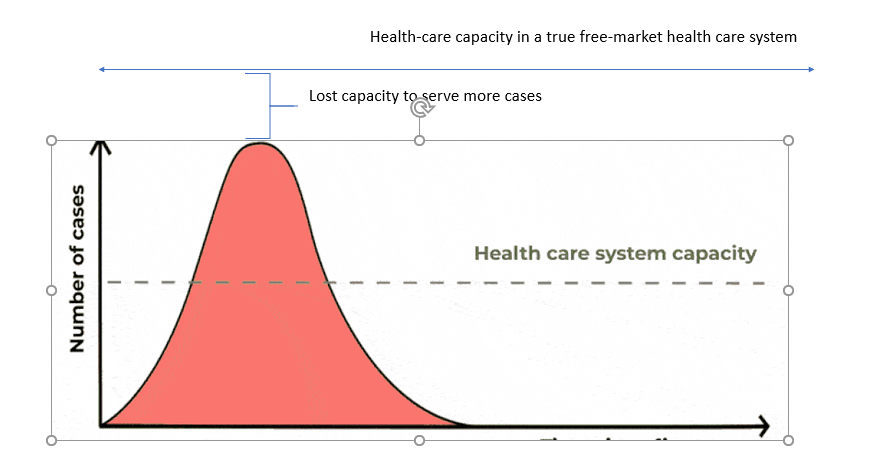
Instead of Flattening the Curve Expand the Curve.


With the coronavirus we have heard time and time again of the flattening of the curve. The basic premise is that we have to stretch out the number of cases of coronavirus due to the restraints within the healthcare system. There is some truth to this given any system can only absorb so much demand  in a finite period of time (there aren't endless resources after all). However, what gets missed in this view is the opportunity of the unseen as so many regulations and red tape prevents the expansion of the capacity for healthcare services.

The first thing to understand is how the government (mainly the CDC/FDA) totally mismanaged the testing for coronavirus. As I detail in my last post detailing how the CDC created it's own faulty test and then the FDA required the CDC to retest every positive coronavirus test for accuracy. If you remember in the early days of coronavirus anyone who tested positive for coronavirus "had" to have their sample sent to the CDC center in Atlanta. Even scientists in Seattle who tried to run their own testing were shut down by the CDC and FDA (their lab wasn't up to Medicare standards). In my last post I detailed the massive amount of regulation regarding lab testing (The Clinical Improvement Act of 1967 plays a large role in this). Also the FDA was asking this Seattle lab to require any of their samples to be run 5 times for accuracy (also this is utterly impractical given at the time there were few cases of coronavirus). Now you sit back and say to yourself how many people have gone un-diagnosed/passed away because of the mismanagement from the FDA and CDC? The FDA/CDC should have immediately let private companies and organizations testing organizations come on the scene to rapidly implement the tests they already have. If this had happened you would have seen tests been quickly deployed and individuals learning whether or not they had the virus so they could have determined whether or not to isolate themselves. Fortunately the FDA has backed down on the regulation front and currently 80 different companies are trying to apply to develop testing. You have companies that are innovating at home tests, blood tests that take 8-10 minutes, and developing processes for testing that the CDC/FDA would never dream of.

There have been talks the United States will run out of hospital beds to care for coronavirus patients. Looking at the data the United States is a little over 6,100 hospitals in the United States (this includes profit and not for profit hospitals). This translates into roughly 924,000 beds that can be used at any given time. However, at any given time roughly 66% of hospital beds are full. Running the quick math this would say that there are roughly a little over 300,000 hospital beds available. If you look back to 1975 there were actually more hospital beds then there are today (back then close to 1.5 million beds and there were also only 216 million people in the country at that time vs. 330 million people today. To translate this number this would say in 1975 we had a hospital bed for .69% of the US population vs. 28% today. Now it should be pointed out that there have been advancements made in medicine that has reduced the need for people to not require hospitalization. Another way to look at the number of hospital beds is per 1,000. The United States has 2.8 beds/1,000 people. Actually this is similar to Italy (3.2 bed/1000 people) and greatly lagging behind South Korea with 12 beds/1,000 people. Moving towards a country with more hospital beds would be a wise decision. However, the regulatory burden to open a hospital doesn't allow just anyone to open a hospital.

I haven't seen anyone study the regulation of hospitals but I did some research regarding what would it take to open up a hospital (this blog gets into the details). Well first you have to get a license from the state (I found the one for Texas which is 14 pages here). Also you shouldn't forget your fire safety report too. Also before you even get state the occupancy of your hospital you have to get approval by the Architectural Review Group of Health and Human Services. The Architectural Review Group has to approve an application before any construction begins (this is about 9 different steps by itself). It is also recommended for the applicant of the hospital to attend a feasibility conference before they get approval. Once all that is approved you will have to pay a license fee of  $39/bed (which is not refundable). Then if you want to get certified by the Joint Commission that will run you about $46,000 per year. If you plan to get any type of funding from Medicare you will have to at least abide by these rules.  Clearly, opening a hospital is time and capital intensive and has large barriers to entry. I haven't even gotten into the certificate of need (CON) laws that allow existing hospitals/medical facilities to block the opening of hospitals that are considering opening which reduces the number of potential hospital beds by tens of thousands.

On the other hand you have innovators like Dr. Devi Shetty who is able to open up hospitals all around the world and a hospital was built at a cost of $700,000 per bed (a 65% discount) to the $2 million per bed it would cost in the United States. These hospitals also negotiate prices with their suppliers. For example when the hospital was looking at disposable gowns one company offered to make the gowns for $75 and the hospital found a factory that could make the gowns for $37. If hospitals in the United States operated liked this not only would the cost of healthcare drop but the quality would increase as well as there would be more competition.

For years I have been saying for roughly the past decade that the FDA has over regulated and has left individuals with fewer options (to treat their own life). If the FDA simply had a longer Phase I trial to just simply test the safety of a drug and report the results and allow patients and healthcare professionals to determine what is best for them (also it is important to note the prices of drugs would decrease as there would be more competition). What people seem to forget is it takes a drug company roughly $2.5 billion of capital and 12 years to bring a drug to market to patients. If you just say the average life expectancy of the America is 78 years you have to wait 13% of your lifetime to watch one new drug get approved. The chances of getting a drug from the molecule level to market is 1 in 5,000. Now the important question to ask is how many drugs that were submitted to the FDA were safe however not approved for whatever reason (the FDA seems to believe we all comprise of the same biology-even though this is utterly insane). On the one plus side Mr. Kevan Shokat (chemist at UCSF is sifting through 20,000 drugs approved by the FDA to see if there are possible drug candidates for coronavirus. Now if the FDA just stuck to approving drugs that were safe that database could be have a multiple of the number of drugs approved today and possibly alleviate some of the symptoms from the coronavirus. Also it is important to consider once a drug is approved it is only approved for one use (cancer, heart issue, etc.). However, the reality is some drugs are used to treat multiple things (example Propecia was used originally used to treat men who had an enlarged prostate but then was found to help men regrow their hair). However, the FDA will not allow companies to tout additional benefits other than what the drug was originally approved for. Once a drug is approved however the FDA can't limit or control how drugs are prescribed. Doctors and patients should be allowed (once a drug is approved) to use that drug in anyway they see fit. Often times the doctor is knowledgeable about the patient's medical history/previous experience with drugs taken/aware of the benefits and side effects of the drug. Also let's not forget patients these days are armed with information too and often times are just as up to speed as doctors for treatments (especially if they have a chronic illness). It is worth noting too that there are specific databases for off-label use were medical providers compare notes on the drugs used, how effective they are, case studies, dosing issues, and the risk/benefit considerations when factoring in whether or not to prescribe certain drugs. The Wolters Kluwer database has over 2400 off-label uses. Allowing researchers/doctors to try different drugs for off-label use may potentially find a treatment to alleviate some of the symptoms of coronavirus.

While we are on the topic of drugs it is important to point out the number of drug shortages. The University of Utah actually keeps track of the drugs that currently have a shortage. As I write this roughly 207 drugs are on the list. Roughly close to 50 drugs have been added to the list within the last week. Again the reason for the drug shortages has to do with the over-burdensome regulation of the FDA. If you have half a day to kill you can read through some of the regulations here. The regulations focus on things like the type of equipment used, the water quality used to make the drugs, how often your facility has been inspected, the records kept by the lab, packaging and labeling, along with personnel requirements. The FDA in recent years has increased their regulation of manufacturers and have adopted a "zero tolerance policy". Drug manufacturers must ask the FDA for approval to make the drug, then get approval on how much of the drug it plans to make, and agree on the time frame. Also if a one drug manufacturer shuts down another drug manufacturer can't increase it's production without FDA approval. Also a program as the 340B drug rebate program allows hospitals and clinics to get discounts (between 13-23%) on drugs in order to provide these drugs to provide to patients on Medicaid (low-income) which then allows these medical institutions that participate in the program to stockpile drugs at a reduced cost. Drug shortages will continue to grow in this time of crisis and not allow patients to truly receive the treatments they need unless the FDA reverses course lightening the regulation and become more flexible in allowing companies to produce the drugs that some people are in desperate need of.

Also some other low hanging fruit is to reduce the regulatory burden on physician assistants/nurse practitioners. Currently 29 states require some level of supervision for nurse practitioners and 20 states require a percentage of physician assistant charts to be co-signed by the physician. There are more than 290,000 nurse practitioners and 118,000 physician assistants. If regulations in these professions were relaxed doctors, physicians assistants, and regular physicians would save tens of thousands of hours that could be used to treat patients who are suffering from coronavirus.

In this time of crisis however there are some creative solutions. For instance empty hotel rooms are being turned into hospitals and even using cruise ships for additional hotel rooms.  Speaking of other sensible regulations that allow individuals who may have an out of state medical license to practice in different states.  Even Medicare has expanded to include telemedicine (it is important to note that private companies have been using medicine for years.

Instead of flattening the curve the focus should be expanding the curve by reducing regulation to allow more drugs, procedures, medical professional and resources to work on the problem. If the FDA and CDC had allowed more testing companies to get their product out to the market more people would have known whether or not they had the coronavirus and then the public would have better information has to who should stay home or who is okay to go out (instead many states have shut down for business). The lack of the number of hospital beds could be greatly helped by reducing the barriers to entry. We need more innovation in terms of letting more companies and individuals open more hospitals that could be housing coronavirus patients. Letting the FDA relax their rules regarding off-label use would work wonders to allow researchers to experiment with any drug that is approved by the FDA may help find some accidental wonder drug that could help. While we are on the topic of the FDA having them back down on the "zero tolerance" for drug manufacturers would reduce the number of drug shortages which is critical in times like this were patients need these drugs the most. Lastly, allowing states to not require nurse practitioners to be supervised or require physician assistants to have their charts co signed by doctors would free up the much needed time of medical professionals to attend to sickly patients who are in need of treatment (and also reduce the work load on these medical professionals who are already burning out). Attacking all of these issues would help not only expand the curve of possibilities but end of saving more lives, improve the quality of living, and reduce the red tape for researchers, doctors, and medical practitioners and result in a win-win for everyone.

Sunday, September 27, 2015

In Defense of Martin Shkreli (Blame the FDA)


So this past week Martin Shkreli who is only 32 years old but is CEO of Turing Pharmaceuticals. announced an increased in a drug called Daraprim which is used to treat toxoplasmosis (parasitic disease), malaria, and AIDS from $13.50 per pill to $750 per pill which represents a 5,455% increase. After public outrage a few days later Martin then announced that they would lower the price of Daraprim. This Slate article describes how if only the FDA had more funding and the government had more control we would see lower prices (in other news pigs fly).

In 2014, only 8,821 prescriptions for the Daraprim were written. According to the CDC there are between 400-4000 new cases in the United States every year and roughly 750 people a year die from it. Also toxoplasmosis can largely be prevented by cooking meat at the right temperature.  I have heard the common argument that the costs to make one pill is less than $1, however people who make this argument are not including distribution costs, FDA regulatory costs, and manufacturing costs that are not included in the marginal cost of less than $1.

According to SEC filings Turing Pharmaceuticals purchase the drug for $55 million in August 2015. The total revenue of Daraprim was about $5 million last year which is hard if not impossible to make any profit. At the previous price of $13.50 there was no one making a profit for it. The CEO claims the company will use their revenues to reinvest in developing a better with side effects. Parasitic diseases can rapidly change and a company needs to perform the research and development now in order to combat future mutations. According to this report death was reported in about 4% of patients who took Daraprim. Some patients have reported vomiting, renal failure, and Stevens-Johnson syndrome. All drugs have risks but the question is can the reward-risk profile can be improved.

It is important to distinguish the market price versus what people actually ended up paying. Even the CEO said that 50% of the customers pay less than $1 for the drug (which in this interview the CEO says in a major impediment to making money).  In the original New York Times article a director of toxicplasmosis at the University of Chicago praised the company for delivering the drug to patients quickly and most of the time without charge. In essence the price that people pay is somewhere between $0-$750/pill even though the stated price is $750 per pill. The company also participates in the 340B Drug Pricing Program which guarantees that Medicaid patients and hospitals get the drug at a reduced price. Alex Tabarrok points out that the prices in India are only going for 5 cents a pill compared to $750 in the United States. Perhaps some capitalists in India could sell their supply to people in the United States for less than $750 in order to increase the supply of Daraprim which would also bring down the price.

The FDA has a burdensome process for not getting a regular drug approved by also even a generic approved. Remember drugs have to first get approved by the FDA which can cost roughly $2.5 billion and take 10-20 years to develop from the research stage to actually being available to the patient. Approval times have only been showing too. In 1960 the average time for drug approval was 3 years and then 6 years by 1965. Companies have between 5,000 and 10,000 substances that they try to turn into the next blockbuster drug but 80% will lose money.

After a drug has been approved it then usually has a patent life between 7-12 years. After this period it then becomes what is known as a generic. Once the drug becomes generic other companies can begin making the drug and as a result the price drops about 30-80%. Even though the drug company spends roughly $2.5 billion bringing a drug onto the market (liberals dispute this figure however they don't understand their is an opportunity costs in dealing with the FDA when they are slow to approve drugs and raising capital) and 10-20 years bringing the drug to market if it wants to make a generic it still has to file an application with the FDA for approval. This whole process of getting the initial drug approve is known as NDA (New Drug Application). When a company is going through getting a drug as a generic it files a ANDA (Abbreviated Drug Application). The bureaucratic organizational chart of how NDA vs. ANDA are approved can be found here.

Some of the rules for generic manufacturers can be found here which are complex and expensive to implement. Last year the FDA announced it was considering adding even more regulation that produces the drug company must work with the FDA on the chemistry, labeling, factory inspections, and testing of the generic. The FDA currently has had a growing backlog for ANDA applications in 2005 the backlog was 780 applications and recently has been as a high as 3000 applications (gee I wonder if any of those applications could be for Daraprim). The fees just associated with the ANDA can reach in the hundreds of thousands of dollars (remember the drug at one point in time was approved by the FDA). The median time of approval for ANDA is roughly 35 months however can be as long as 89 months.

The high price of Daraprim signals to people that they have to try alternatives first. Also the high prices are incentives for other companies to take a look to see whether or not it makes sense to make Daraprim. Doctors and patients will experiment with other drugs before using Daraprim. Turing has about 2-3 years before they should expect competition from other companies. Turing paid $55 million for a $5 million drug (in revenue-remember you only get to take home profit not revenue) when less than 9,000 prescriptions for the drug was written every year. If you divide out $55 million by 9,000 that is roughly $6,000 per prescription. The cost of treatment for the full course of Daraprim is roughly $63,000 however can vary depending how severe it is. Assuming 9,000 people took the drug that turns out to be $567 million of revenue. When we factor in that 50% are getting the drug for $1 we can halve the revenue number to $287 million. Remember this is revenue not profit. The average profit margin for generic drug makers is actually negative -4.2%.

A wiser approach is for people to get outraged at the FDA for increasing the time and cost to get drugs to market. If it took 10 years and $1 billion out of pocket to make a drug (this is before including cost of capital) you would be forced to charge a relatively high price. The FDA needs to be reformed to allow faster innovation to create more competition which will only drive down drug prices. Reducing the number of phases that drugs have to go through from three phases to just one phase and only requiring that a drug be safe to get approved would drastically lower the cost of drugs. Everyone has different bodies and chemistry within their body and the FDA shouldn't get to decide how effective a drug is for me since it will be obviously different for everyone.

The other obvious no brainer is to allow more prescription drugs over the counter which would increase there availability (often times patients must get pre-approved by an insurance company before taking certain drugs-which ends up wasting both time of the doctor and patient). People would have the fear that consumers won't consult their healthcare professional when the data shows 60% do when purchasing over the counter drugs. Switching from prescription drugs to over the counter drugs could save roughly $5 billion for just upper respiratory infections alone. You can easily see how doing this for many different ailments would start adding up and not require people to stand in line at Walgreens/CVS waiting to refill their prescription.

If the FDA reduced its burdensome regulation it would allow more companies to bring their products to market which would create more competition and reduce prices for everyone.  Creative destruction needs to be brought to the drug development industry just like Uber has disrupted the taxi industry or Airbnb has disrupted the rental market industry. The FDA burdensome process will not only not allow patients access to drugs they want but also force consumers to pay higher prices than they otherwise would have paid under a free market system.

Wednesday, March 12, 2014

FDA Make Another Boneheaded Move on Lemtrada: Meanwhile Patients Suffer


I recently was reading this article and started to get somewhat frustrated while reading it. Basically the FDA recently announced that last December a drug called Lemtrada which is used to treat people with multiple sclerosis (MS) was not approved because according to the FDA the studies were not adequate and well controlled.

The drug Lemtrada is used to currently treated people with leukemia. The drug is an intravenous drug and produced by a company called Genzyme. The drug has been approved in Canada, Australia, and even all members of the socialist European Union (according to this Wall-Street Journal article). One no brainer for the FDA is to have reciprocal approval with other countries-so if Canada or Switzerland approve a drug by their equal FDA than it should be okay for the United States.

When the trials were conducted they found a 50% decrease in symptoms (1,400 patients took this drug). The nice thing about the drug is that you only have to administer it essentially once a year as opposed to taking numerous pills and multiple weekly injections from other MS drugs.  We have to remember that these patients are real people with a real illness who I would imagine spend a fair deal of time worry if they will ever get better. The FDA said the issue with the trial was that it was not double blind (which is the gold standard for FDA trials). However, if you have a serious chronic illness and you actually do get the placebo (sugar pill) and get worse and worse who does that help? Doctors and patients correctly pointed out that Rebif which already FDA approved did not used double blind trials when it was going through approval.

The only thing Genzyme can do now (after it has already spent many years and hundreds of millions of dollars in running the drug trials) is to run a double blind study trial which would take at least 2 years and would cost another $100 million for a drug that nearly every other rational country has approved.

The FDA approval panel should have a rule that states "you must have a loved one, family member, or someone you deeply care about that suffers from the illness from the drug you are trying to decide on". If this where the case I would imagine different results if they actually stopped to think how many people are harmed by the FDA holding back drugs to people with chronic illnesses. Maybe the FDA needs a mental evaluation.

Wednesday, December 28, 2011

Big Pharma’s New Business Model: FDA Does Harm

In today’s Wall-Street Journal Dr. Scott Gottlieb points out the obvious problems of the FDA. Gottlieb argues correctly that advances in medicine have been hindered by too much regulation. The average cost for a drug company to create just one pill is roughly $1 billion. The FDA now requires more patients, more tests, and I believe regulates to the point where they create drugs that are too safe. The number of patients required for clinical trials have increased from 1,600 in the late 1970’s to roughly 4,200 in the 1990’s. This of course creates additional costs for the drug companies. Today the cost of enrolling just one patient in phase III (final stage) trials is $26,000. In 1987, the cost to develop a drug was $437 million (in 2010 dollars). By 2000, this number increased to a little over $1 billion (in 2010 dollars). The question is what is driving up the cost?

Note this is just for one patient. The number of tests that must be done on patients (blood work, x-rays, etc) has from just 1999-2005 has increased 59%. During this same period the amount of time required to complete clinical trials has increased 69%. The percentage of drugs getting approved has also decreased. 63% of drugs advance from Phase I to Phase II testing. However, only 33% of Phase II drugs get into Phase III. At Phase III the chances of a drug becoming approved are 80%. The percentage of drugs that get passed has been decreasing over time.

The FDA is focused on making sure that drug companies are producing safe drugs. The FDA can restrict what drugs people choose to take. This to me doesn’t make a lot of sense considering we choose what to eat, drink, and do with our bodies. The most common argument about why we need the FDA is because people simply don’t know enough about drugs. True, individuals themselves may not however this is why people seek out information. People can get vast information about diseases, illnesses, and drugs online. Individuals can evaluate their own risk-reward models. No system will be perfect. However, the question is what leads more people better off. Right now many people are suffering from pain and illnesses because the FDA won’t let XYZ drug company test their drug. One great idea is if patients want to take a drug not approved by the FDA to sign a waiver from the drug company saying that they can not later come back and sue. The FDA has little or no incentive when it comes to approving a drug. Have you ever heard of patients suing the FDA for not approving drugs that could have potentially saved lives?


Saturday, March 14, 2020

Why the Private Individuals and Organization Are Ahead of the Government in Responding to Coronavirus

Image result for coronavirus

For the past couple of weeks coronavirus has been in the news. Back in Dec 2019 China had a number of cases of pneumonia and then within the first week of December 2019 the Chinese government confirmed that these individuals actually had confirmed this was coronavirus. Since then there has been fear, angst, and anxiety around the world regarding how quickly the coronavirus has spread (as a result people are hoarding toilet paper, antibacterial soap, and bottled water acting as if the world will end). While I feel the spread of the coronavirus is awful I believe the federal government has only made the problem worse with excessive regulation and now allowing the decentralization of decisions from private companies, individuals, and organizations to override government power. Some companies have voluntarily told employees to work from home to avoid the spread of the virus while others have even created their own coronavirus schedule. Luckily there are some individuals and private organizations that are helping out.

The first major issue has been the ability to test individuals who have the coronavirus. During the months of January and February 2020 the number of coronavirus cases in China was rapidly increasing however The Centers for Disease Control (CDC) decided to create it's own test rather than use the World Health Organization (WHO). The CDC has issues in terms of having people testing positive (who actually didn't have the disease).  What is insane is the FDA requires the CDC to retest every positive corona virus test run by a public health lab for accuracy (the CDC is also the same organization that predicts 1.7 million in the U.S. will die from coronavirus).  I remember hearing on the news that samples for the coronavirus "had" to be sent to Atlanta first and having the thought "why?-surely there are thousands of other labs in the country that could test for coronavirus". 

Now take the case of a German scientist named Olfert Landt within 10 days after the New Year created a viable test kit for coronavirus. Landt and his team worked 12-14 hours per day (his son works a "part-time 60 hours a week" job) and within the past 2 months the company has created 40,000 test kits. The test kits run about $180 each and he has received orders from all around the world. The company has produced enough test kits to have 4 million individual tests. What is interesting is the test is just a throat/nasal swab and the results can be found within a few hours. The WHO began shipping these tests out February 1, 2020. The CDC created a test was then approved by the FDA on February 4, 2020. However the results of the CDC test were flawed as an ingredient in the CDC test created false results. It wasn't until February 29, 2020 that the FDA allowed hospitals to use their own tests for coronavirus. 

There are even situations were individuals take testing matters into their own hands and the government shuts it down. Dr. Helen Y Chu (she went to Duke for medical school and taught at Harvard Medical School) in Seattle who is both board certified in infectious diseases and internal medicine. The Seattle Flu Study (funding came from the family office of Bill Gates) studied individuals who were both health and sick individuals to try to help the city of Seattle detect the flu earlier, develop new ways to treat, and help the city prevent outbreak. The Seattle Flu Study is constantly taking nasal swabs from residents in the area so had good data on what the general flu looked like. On February 25, 2020 Dr. Chu and her team couldn't wait any longer and decided to take matters into their own hands and began performing their own coronavirus tests. The government from both federal and state levels had told Dr. Chu and her colleagues that no they could not create their own tests for multiple reasons. The first is patients never gave their explicit permission, and the labs were not certified by the FDA because the lab would have to meet Medicare standards-this could take many months before approval. The FDA for example would require the test to be run 5 times on the sample sample to validate it (which is insane since the number of positive cases for coronavirus is so few given the lack of testing due to government mismanagement). The CDC promised kits would be distributed within days (days would turn into weeks). It wasn't like you had Elizabeth Holmes running these tests. The CDC told the Seattle Flu Group creating their own test would not be possible. The CDC and FDA told Dr. Chu to stop testing thousands of samples they had already collected from individuals. During this time 22 people were dying from coronavirus. 

So not just anyone can start a lab (this isn't Breaking Bad). In order to be certified by you first have to comply with The Clinical Laboratory Improvement Act of 1967. Let's not forget the Clinical Laboratory Improvement Amendments of 1988.  The 1988 was passed in response to false negative Pap smear tests. Also let's not forget each state may have their own regulations which may be even more stringent than the federal laws. Under this act any facility that performs testing under the law is considered a lab-even if only a few basic tests are performed and the lab isn't charging. If you want to start a clinical laboratory. Here is the 10 page application you have to fill out to get certificate from Medicare. The certificate is only valid for a 2 year period. Oh and before signing the application you must make sure you comply with Section 353 of the Public Health Service Act you could possibly be imprisoned for up to one year. Let's also remember if someone violates the regulations they could face possibly: criminal penalties, up to a year in prison, a fine of $10,000 per day, and possibly not able to participate in other federal programs. In 1995, inspections showed that 80% of labs had compliance issues. Thankfully Medicare publishes the top 10 deficiencies of labs. Regulations also specify who can work in the lab. For example an individual that performs "high complexity testing" must either be a doctor or have at least a science undergraduate/associates degree with 60 semester hours of sciences (chemistry/biology/etc), complete a training course, have at least 3 months of laboratory training in each specialty in which the individual performs high complexity testing. So if you were a philosophy major don't bother getting near a laboratory. It should be pointed out that the smaller to medium size laboratories are not getting rich either. About 50% of laboratories have a profit margin at 3% or less (meanwhile companies like LabCorp/Quest Diagnostics and other labs are able to generate much higher profit margins because of their scale and size). Medicare recently also increased the fees on these labs by 20%. Now depending on the type of lab (determined by how many tests are performed each lab could be paying up to tends of thousands of dollars for each certificate.  

As I write this 9 different companies are working on a vaccine for the coronavirus. It looks like Gilead Sciences is the furthest along with an IV treatment (remdesivir) currently in a Phase 3 trial (the treatment has already been used on a woman in California who was on the verge of death who improved after taking the drug (it should be pointed out it took the CDC 4 days to just to agree to evaluate the samples (it didn't meet their strict criteria) and then another 3 days for the results to come back. As her health declined her doctors at UC Davis applied for compassionate use (the drug manufacturer has allowed hundreds of patients to try remdesivir) from the FDA which would allow patients that are not part of a clinical trial to test a drug. Also it is believed that the earlier the drug is administered the higher probability there is to help the patient. The government wasting time telling a patient they are too sick to get treatment most likely made the woman worse off than she would have otherwise have been. Also if someone is dying don't they have a right to their own life and what treatments they receive? As I write this a Canadian company has said it has a "vaccine candidate" just 20 days after obtaining the gene of the virus and once they get the green light could produce 2 million doses/month. My question is why can't patients work privately to determine what drugs are best for them? Most likely by the end of the year with all these companies working on vaccines and probably even more will try to enter to create a vaccine (remember it usually takes 10-15 years to create a vaccine). 

Speaking of testing just yesterday the FDA approved a test (as I write this the first approval from the FDA from a private company-the only other approved tests are from the New York Department of Health and the CDC). According to Roche the company can provide millions of tests every month and can test patients 10 times faster than their old system. Speaking of testing as I write this there is a testing capacity of ~27,000 patients per day. It is important there are over 260,000 clinical laboratories in the country. Although hospital labs are only roughly 5% of the labs they perform 55% of all the lab testing. Innovators and entrepreneurs have came into the market and are offering different ways to diagnose coronavirus. One small biotech company called Aytu Bioscience in Denver will be able to test for the virus with just a small drop of blood within 10 minutes! This blood test has already been used in China for the past 6 weeks (however the company needs to get emergency approval from the FDA). There has even been some innovation with setting up drive through coronavirus testing. Speaking of Colorado another company has devised a UV light that kills 99.9% of bacteria and viruses (however it is not known if it can kill the coronavirus but the companies believes it can). Entrepreneurs, companies, and organizations are much better at quickly adapting to solve problems (even in national pandemics) then government entities given the incentives at stake. The market would develop a coronavirus test that could be ordered off Amazon Prime or have someone pick up at Wal-Mart/Target/CVS. 

Many people have talked about how the hospitals will be overburdened with the coronavirus as a result of many people possibly needing to be hospitalized. One big issue is that certain states have are certificate of need (CON) laws that prevent just anyone from opening a hospital or medical facility without first getting approval from the state. There are currently 36 states that have CON laws. A study showed that having these laws actually reduces the number of hospital beds to patients (beds that could be taking care of patients with coronavirus). In some states this can add up to 10,000-20,000 hospital beds for some states. Now when you aggregate all the states that have these laws you are looking at many thousands of people who wouldn't be able to access healthcare because of regulation.

It is important to note much of the advancement in fighting the coronvirus has come from private individuals and organizations. Scientists from around the world were the first to sequence the genome of the coronavirus and put it online for others to study. A German company created a testing kit that is now being used around the world (while the CDC couldn't even get an accurate test out and could only produce it in limited quantities. Compare this to the power of Roche, LabCorp, Quest Diagnostics who were ready to step in with their tests (these companies can run substantially higher number of tests and more accurate than the CDC testing), however were blocked by the FDA and the CDC. The many weeks of delay from the FDA and CDC could have allowed individuals to get tested for the virus and given them the knowledge to know whether or not they poses a risk to others. The U.S. government knew for many months of the coronavirus and it looks like finally this coming week will have enough tests for people. Also you may have many people worrying if they have the disease which may cause them anxiety and panic for the fear of not knowing. I have no doubt that a private company or organization will find a vaccine for this virus. The real heroes are those individuals who are working day and night trying to advance the understanding, treatment, and hopefully cure for the coronavirus. The coronavirus like many other things has taught us that viruses move much faster than government bureaucracy and red tape. The collective efforts of Gilead, Roche, Olfert Landt, Dr. Helen Chu and Aytu Bioscience have done more to help individuals around than the FDA or CDC could ever dream of. 

Sunday, January 8, 2012

War on Cancer Failure

In 1971, President Richard Nixon declared a war on cancer or what is known as the National Cancer Act of 1971. I hate when politicians say things like we have a “War on Poverty” or a “War on XZY”. The only thing this really means is a massive amount of money will be used to fund whatever the war is for. It isn’t as if people didn’t get cancer before the 1970’s the government just decided we should use more tax dollars to fund it.

A recent report from the American Cancer Society found that the death rates for all cancers decreased 1.3% per year from 2001-2006. This is of course after a 21% decrease between 1990-2006. The five year survivial rate for all cancers has increased from 45% in 1975 to 68% currently. One cancer that has seen a large increase in survivial rate has been prostate cancer. The survival rate in the 1970’s was 67%. Today the five year survivial rate is 99.9%. Some cancers have made very little progress in finding any treatment. For instance, there is very little that can be done for pancreatic cancer. The one year survivial rate is only 25% while the five year surivival rate is a miserable 6%.

After looking at this data one might thing well things are getting better. However, one could make the argument that things could be greatly improved. The greatest enemy in the war against cancer is the FDA. It currently takes hundreds of millions of dollars and nearly a decade of research to bring any drug to market. In the meantime while drug companies are trying to get their drugs approved hundreds of thousands if not millions of people suffer as a result. Once a drug is approved however the FDA can’t tell doctors or patients how to use those drugs. This leads to what is known as off-label usage. Off-label usage occurs when a drug is approved for a certain ailment, however doctors experiment and prescribe the drug for a different ailment. A study from Mark Ratner and Trisha Gura in 2008 showed that 50%-70% total usage of cancer drugs are off-label use. It would make sense cancer drugs would have probably the most off-label use since these people have the most to lose. The number of patients just to run trials for the drugs has increased. In the late 1970’s only 1,600 patients were needed. By the 1990’s this number increased to 4,200. This has substantially increased the cost of trying to bring the drug to market which decreases the number of people that can benefit from the drug. People often complain about greedy drug companies. This if of course looking at the effect without looking at the cause. The reason why drug companies charge high prices is because their costs are high due to regulation. The business of creating drugs is based on failures. Drug companies know they will have many of failures which is reflected in the price of blockbuster drugs. The reason drug companies have failures is because the FDA overzealously is obessed with the safety of a drug. The FDA needs to understand that there is no thing as a perfectly safe drug. The question is how to improve the quality and quantity of live in individuals. Of course, there will be trade-offs but let patients and doctors decide. One no brainer solution is once a cancer (or any drug) has passed the first phase of FDA to allow it to be used in the market. The purpose of the first phase is to determine whether or not a drug is safe. Once a drug is determined to be safe by the FDA patients and doctors can run their own experiments to see whether or not it works. Different patients will of course react differently to drugs. By allowing more experiementation there would be more data and knowledge about the drugs which would help drug companies, patients, and doctors. If drug companies were worried about liability they could have patients sign waiver forms or enter into some type of contract that would say if the patient is harm the drug company has to compensate them.

The FDA is creating chronic inflammation in the drug discovery process. Today, patients often have better and more information than doctors of yesteryear. Decentrailizing power and allowing patients and doctors to make their own choices will only improve things. I personally don’t think “cures” exist given one important rule of economics. In life there are no solutions just trade-offs.

Saturday, August 27, 2016

EpiPen Price Increase: Blame the FDA Not Mylan


Well everyone this week everyone was up in a big roar about the generic drug company Mylan increasing the price for their flagship drug EpiPen. The company is alleged to have "gouged" customers as it increased the price of the drug (a pack of 2-EpiPens) from $94 in 2007 to $608 in 2016 (a 550% increase). Even the liberal Los Angeles Times believes that there should be more competition for generic forms in this space. EpiPen is an autoinjector pen that is used when people having allergic reactions. A reaction can occur from a bee sting, food, allergy, insect bite, etc. It is important to note that you need a prescription to obtain EpiPen (regulation numero uno). Full disclosure my father actually had to take an EpiPen when he had an allergic reaction to a prescription drug he was taking. It is worth noting that if patients who have an allergic reaction could possibly die/life altering complications if they don't take the EpiPen. The one issue with the EpiPen is that it only has a shelf life of 12-18 months. After this period of time the medication no longer works.

Politicians like Presidential nominee Hillary Clinton labeled the price hikes as "outrageous, and just the latest example of a company taking advantage of consumers". Of course charging hundreds of thousands of speaking fees is not outrageous. Most likely there will be congressional hearings over the price increase of the drug. Mylan CEO Heather Bresch explained told the New York Times that "I am running a business. I am a for-profit company. I am not hiding from that".

As I wrote in this blog post it takes considerable time/money to bring a drug from development to the market (roughly $2.5 billion and 10-20 years from the research stage to being available for patients). After a drug is approved and has been on the market for a number of years generic drug companies can come in and make the drug and try to sell it at a cheaper cost to consumers. The rules for generics can be quite complicated as seen here (generics have to have the same chemistry, manufacturing, labeling, inspections, and bio equivalence just like FDA approved drugs have). All the steps for a drug to be approved as a generic drug can be found here. The drug companies have to go through a whole new process with generic drugs with the FDA even though the drug was already approved! The FDA has a backlog of 3,000 generic drug applications as recent as 2014. Perhaps one of those backlogs could be a competitor to EpiPen in the future. The time to approve a generic drug can take up to 89 months. Remember the 89 months is after a drug company spent 10-20 years researching and developing a drug.

Sales of EpiPen have increased in the past decade from $200 million to $1 billion which is creating shareholder value when you have a a pen that literally can save lives-is $600 a lot if it can save your life?. In 2014 the company hit $1 billion in sales with EpiPen. The media will perhaps cite the fact that Mylan brought in $9.4 billion in revenue (the media is economically illiterate and doesn't understand the difference between revenue and profit).

In 2015 Mylan made a net income (the money the firm has after all the bills are paid) of $847 million. So when you divide $847 million by $9.4 billion means that for every $1 of sales Mylan was only making 9 cents. Another way of looking at it is saying that if there are 365 days in the year Mylan only made money 37 days out of the entire year! Mylan only receives $247 of the $608 list price it charges. The remainder goes to insurers, pharmacy benefit managers, wholesalers, and retail pharmacists (middle men). The company recently said that it would offer up to a $300 coupon. The company also said it would give free EpiPens to uninsured patients if their incomes were below 400% of the poverty level. One idea might be to cut out the middle man and sell it directly to the consumer. Well this won't happen given EpiPen requires a prescription from a doctor (another barrier to entry).

In 2014 Mylan reached $1 billion in revenue for EpiPen. Around this time the cost for EpiPen was $380. Now considering Mylan only receives 48% of this (pays rest to insurers, wholesalers, etc) you could estimate that Mylan sold roughly 5.4 million EpiPen packs in 2014 (this looks close if we look at the quarterly sale data here). CEO Heather Bresch earned $25 million in 2014 (although most of this compensation is in the form of stock securities which can't be accessed for many years but still counted as compensation). Now if the CEO was paid $0 it would only in a price reduction of EpiPen by $5!

With all this however there is good news. There is actually an alternative to the EpiPen called Adrenaclick which sells currently for about $142 (a 77% discount from what EpiPen is selling for). What is even more interesting is no one has talked about this. Some other no brainers would be to not to require a prescription for EpiPen which would allow the company to sell directly to consumers. Also the FDA needs to speed up the approval process for generics of the drug which will create more competition. Generic drug maker Teva tried to get their drug that was similar to EpiPen approved however the FDA didn't approve it citing deficiencies. Although the drug could be out as early as 2017. In addition to this Adamis Pharmaceuticals is working on a possible alternative too which could be 40% less than the price of the EpiPen. Also add in Windgap who is trying to get a EiPen alternative approved too (a product called Abiliject). Windgap hopes to have the drug out by 2018. Although, my hunch is the FDA will tell these companies they have deficiencies of one kind or the other and need more data and studied to be conducted.

What is quite clear is that the FDA continues to harm consumers by not being quick enough to approve new drugs, forcing companies to spend decades and billions of dollars to bring a drug to market and then the public/politicians get upset when the companies raise their prices. If we allowed true free markets more people would have access to EpiPens at a cheaper price which is a win-win for everyone (except politicians because they would have less power).

Tuesday, July 3, 2012

GlaxoSmith $3 Billion Fraud, Off-Label Use, and Dr. Drew


I woke up this morning and read a story about GlaxoSmith paying out $3 billion in a fraud settlement. At first I was thinking some plaintiff must have been injured however when I read the story I learned that GlaxoSmith was ordered to pay out billions of dollars simply because they were marketing drugs for what is known as “off-label” uses. Off-label use occurs when say a drug is approved for cancer but a doctor prescribes it for something else because they believe it will help. In Glaxo’s case they had a drug Paxil which was used for treating depression however wasn’t approved for treating in depression in anyone under 18. This is somewhat bizarre considering it is treating depression for different age group. How exactly is this an “off-label” use? The other drug was Wellbutrin which was approved for depression however GlaxoSmith promoted from 1999 until 2003 for ADHD, weight lost, sexual dysfunction, and substance addictions. Speaking of substance addiction Dr. Drew was actually linked to this case as he was paid $275,000 for in the 1990’s for being involved in a two year project that looked at intimacy and depression.

What is curious however is that this was labeled as fraud yet how many consumers where hurt? Actually many people were hurt by not being allowed to use the drug for off-label use that could have benefitted them. Patients are not going to take something for an off-label use unless they first go to an American Medical Association approved doctor and then have that doctor write a prescription for a drug that was approved for some other use (which cost the drug company $1 billion to make and at least ten years of research.  The reason there is so much off-label use is because the FDA is zealously over regulates even approved drugs. Even if a FDA drug is approved for one illness it has to go through the whole FDA process again to get approved for another illness. This increases the cost to the drug company which is just passed on to the consumer in the form of higher drug prices.

As I have said many times two things that would drastically decrease the price of health care is getting the American Medical Association out of the business of determining who becomes a doctor and getting rid of the FDA. In a free-market consumers would decide whether or not a drug was effective. If a drug company sold people drugs that didn’t work the drug companies would still get sued. Fraud is frowned upon in free-markets since companies do have reputations which affect the value of the company. The effect of having the FDA regulate drug companies to death is only a few companies with blockbuster drugs.  If the FDA was abolished there would be more drug companies, more options, which would in time lead to more effective and safer drugs.

Saturday, April 28, 2012

FDA: Stifling New Cures


In this report by Avik Roy of the Manhattan Institute finds that the cost of Phase II trials is increasing the costs of drugs. Roy finds that 90% costs related to the development of a drug occur in Phase III. Roy response is to allow drugs that have passed Phase I and Phase II trials to be marketed to patients. This is something similar to what I have purposed, however I would be okay with letting drugs on the market once they have been approved from a safety standpoint. Since everyone has different body chemistry, cells, and since no two people are alike it is unwise for the FDA to make a blanket statement when they disallow certain drugs that could clearly benefit certain individuals.

The costs of drugs according to the Tufts Center for the Study of Drug Development have increased from $100 million in 1975 to $1.3 billion (in 2000 dollars). The cost even after adjusting for inflation has dramatically increased. One reason the costs have increased is because the trials have required more patients, more resources, longer trial periods, and more medical tests to be performed. In 1999 the average length of a clinical trial was 460 days. By 2005, the average increased to 780 days (or just over 2 years).

The author’s suggestion of allowing limited marketing before Phase III is a step in the right direction. I would also want to not require prescriptions for drugs. What is really interesting is why people need to waste their time to make an appointment just so a doctor could renew a prescription (think of how wasteful it is for someone to make an appointment with a dermatologist just to get face wash). If a prescription weren’t required people would still go to the doctor for medical advice. Also moving drugs from behind the counter to over the counter would dramatically drop prices since places like CVS, Walgreen's, and Wal-Mart would all have to compete with each other. The most important point however is that people along with their doctors could experiment with different drugs to see if they helped. This would allow for more information to be spread to the masses which in the long run would benefit everyone. Some people might get hurt in the short term but in this world we do face tradeoffs.

It seems puzzling that year after year the FDA increases regulation when we have more data about who we are and how we operate. Medical data has exploded in the past few decades leading doctors and patients to know more about certain conditions. In some cases now patients know more than some doctors especially if they have a certain illness. Doctors sometimes will look up symptoms during a patient’s visit to pinpoint exactly what they might have. Also with genome sequencing doctor's can look at a patient’s DNA and have a better understanding of what illnesses or diseases they may get face in the future. With all this information you would think the FDA would be regulating less. Knowledge is power and there is no question the FDA is doing more harm than good. 

Thursday, August 4, 2011

Pfizer and Over The Counter Lipitor

I read an article in today’s Wall Street Journal that discussed Pfizer trying to get the FDA to approve Lipitor for over the counter use. The patent for Lipitor expires by the end of this year and Pfizer wants to make sure that people are still aware of the drug. Drugs get a patent for a decade. After a decade the drug company loses the patent to make the drug and a generic substitute comes onto the market. People often say the generic is exactly like the original drug however this is a little misleading. The original drug can have a better quality delivery system, higher self life, and more effective even though the molecules for the original drug and the generic are the same.

Pfizer being very aware that Lipitor is going to become a generic drug wants to allow consumers to purchase the drug without the prescription (known as over the counter). I have always wondered why the FDA has not made more drugs over the counter. Many drugs that you need a prescription for are not very dangerous. Plus, if consumers really wanted to do harm they could just up the dose on over the counter prescriptions already.

There are benefits to putting prescription drugs on the market. The first if the drugs were allowed to be sold over the counter more people would have access to it. Drug stores and regular stores would have to compete on drugs which would reduce the price of drugs. Also another benefit would be since people are sometimes reluctant to go to the doctor you would provide them with the opportunity to take particular medicines.

The FDA worries about people taking the wrong dose or possible drug interactions which is understandable. People care more about their risk tolerance profiles than any bureaucrat. Plus, no doctor has perfect knowledge of any individual patient. Patients when they are in need seek information. I really don’t find the argument of “people don’t know what’s good for them” very compelling. Today, we have more information than leading doctors did 20 years ago. I would be more sympathetic to this argument if it were made decades ago.

Allowing people to take drugs without a doctor’s prescription would not only increase quality of life but lead to better information. Doctors could run their own trials with patients and measure the effects of the drugs on people. I don’t see why a drug should have to go through the FDA again for non-prescription use after the FDA approves it.

Sunday, April 28, 2013

New York Times Doesn't Understand Why Cancer Drug Prices Are Over $100,000


I recently read this New York Times article and was quite irritated. The story is about the high cost of cancer drugs. Even the American Society of Hematology said we need to lower the price of drugs in order to save lives.

The New York Times fails to understand why the drug prices are so high. First, the FDA makes it very costly to get a drug to market to help people. Phase I, II, and III trials have to be done. Even after the drug is approved the drug has Phase IV where the drug company monitors adverse reaction. As I mentioned in this post the number of patients required for cancer trials has drastically increased over the years which has made the cost of doing clinical test extraordinary. According to Tufts Center for Study of Drug Development the cost of developing just one drug has increased from $100 million in 1975 to $1.3 billion (both in 2000 inflated adjusted dollars). Meanwhile the number of patients required for clinical trials has increased over 160% (between just the 1970’s and 1990’s). Avik Roy from Forbes pointed out that 90% of the costs occur in the final phase (Phase III) of the clinical trials. A drug once it gets into Phase I has about less than a 16% chance of getting approved (note that drug companies test thousands of different compounds before the drug even goes into Phase I trials). So drug companies are spending $1.3 billion and have an 84% chance of their drug not getting approved. This is why they have to charge more for the drugs that do actually get approved. 

Dr. Brian Druker of the Knight Cancer Institute at Oregon Health and Science essentially does not like the profits drug companies are making and asks the question “if you are making $3 billion can you get by with $2 billion”. The profits drug companies make are used to research and develop other drugs. The reason why drug companies have profits are because they invested billions of dollars to develop drugs. Drug companies can’t sit idle with just a few good patents they have to constantly be innovating and developing newer drugs. Actually the FDA makes this worse because the general patent on a drug once it is approved is 10 years. I would be okay with shortening this patent life to say 5 years if the FDA allowed drugs to be marketed once they passed Phase I clinical trials. Phase I looks to see whether the drug is safe (which is what doctors and patients care about most). Researchers, individuals, and doctors can on their own figure out if the drug is effective (given everyone has a different body, different cells, and different DNA). If you shortened the patent life to 5 years and allowed drugs on to the market after Phase I clinical trials you would see a sharp decrease in the price of drugs. In an odd way the FDA does make drug companies riskier. If the FDA were to increase the number of drugs approved, and also shorten the patent life then drug companies would have a more diversified portfolio since they would have more products on the market (and not have to rely on just one or two drugs).

Doctors and the New York Times forget many horrible conditions have at least some form of treatment that is much cheaper than the $100,000 drugs. Many drug companies offer assistance programs to patients who can’t afford their drugs. True the alternative may not be as good as these new drugs but until the drugs go off patent they will be high. Somehow people want to live in world were we have first class health for a low price. I suggest the New York Times take an economics class at George Mason University.  

Saturday, January 2, 2016

A True Free Market Libertarian Approach to Health Insurance/Medical Care


Many people have lamented over Obamacare (even some Democrats). Republicans in a way to counter Obamacare have offered very sparse and generic reforms such as "allow people to buy insurance across states" and "health savings accounts". I divided the post into a few parts: the problem and go on to discuss what causes the problem of high medical prices and then offer some solutions that could be used to reduce the cost of medicine, allow more access, and improve the quality.

The Problem
The reason healthcare is more expensive is because individuals are not directly paying for the services rendered. People have little incentive to shop if the government or an insurance company is paying most of the bill. Between 1960-2009 the percentage of consumers who directly paid for healthcare expenses dropped from 48% to 12%  while the percentage that government paid increased from 24%-48%. The government in this report seems happy that improper Medicare payments are only 10% of the budget. During the same year (2013) Medicaid only made improper payments of $14 billion of improper payments. Why would any one trust the government when it comes to healthcare when the government misappropriated payments from Medicare, Medicaid, and other tax credits that totaled roughly $125 billion.

When you go to Wal-Mart, Amazon, or McDonald's you see a price posted and you can either purchase the item or leave. As University of Chicago professor John Cochrane points out in this excellent essay "the Cheesecake Factory delivers a complex service oriented business product with remarkable quality, efficiency, and cost. Why can't hospitals do the same?"

What Did We Do Before Health Insurance?
Before insurance companies ever existed there were such things as mutual aid societies were individuals essentially form their own insurance company by getting groups of people together and each contributing about $2/day (which was the wage for a day of work). Let's not forget people in the early 20th century worked more hours than people do these days. During the 1920's the value of these societies was $9 billion. Mutual aid societies could limit who was in their group (insurance companies have to take on anyone who applies). What is even more interesting is that the mutual aid societies had a 30% lower mortality rate than the general population!  The government of course didn't approve of this and in 1919 passed the Mobile Law which increased the reserves that mutual aids had to keep, required a doctor to examine all lodge members, and the lodge couldn't extent credit to members. Slowly over time the government increased the regulations which reduced the importance of a voluntary market for health insurance. If me and a couple of friends want to form an insurance pool why should the government stop us?

Health Insurance Problems-Deregulate this market
With Obamacare health insurance companies are subjected to medical loss ratios. This ratio essentially dictates how much health insurance companies can spend on medical care from the premiums they collect. Currently the ratio is 85% which means that if there is $100,000 paid in medical premiums at least $85,000 has to be for medical care. Essentially this rule came about because people believed that insurance companies were greedy (remember insurance companies make less than a 4% profit margin) and that insurance companies will only spend their money on advertising and marketing to try to lure customers in. However, the flaw with a medical loss ratio is requiring a health insurance company to spend 85% of the medical premiums on health care it creates incentives for health insurance companies to overspend since the insurance company is required to spend the money within a one year time frame. This incentive leads health insurance companies to spend more on the latest technology (MRI machines, CT scans, etc.)

Community rating laws are another form of regulation that essentially say that everyone that buys health insurance even though people vary in: age, sex, height, weight, lifestyle. The only thing that health insurance companies can charge different prices for is whether or not a customer is a smoker Community rating laws only exist in health insurance. Car insurance companies can increase your rates if you are younger and more reckless but not health insurance companies. If you look at what insurance at companies are required to cover this also drives up the cost of health insurance. For instance, health insurance plans must cover things (a list of 10 things here)  mental illness, lab tests, preventive and wellness service, maternity care, and many other things. Why can't we customize our health care plan to our own needs? Speaking of that under Obamacare policies have unlimited lifetime limits (meaning there is no maximum dollar amount your policy can cover). Why not allow there to be a market to allow people different amounts of lifetime coverage ranging from $50,000 to a couple million?

Looking at the health insurance market the market itself is not itself competitive. All insurance companies (whether it be health, auto, life) are first regulated at the state level. Usually every state has their own insurance commission. Health insurance companies have to abide by risk based capital requirements which looks at the assets of the insurance company to make sure they have enough of a surplus. Also another thing that state regulators look at are the insurance financial statements to make sure the insurance are financial solvent. On a regular basis state insurance department audit health insurance companies. There are also rules regarding how much health insurance can increase premiums at the state level. I looked up the rules for how to incorporate an insurance company in Texas and realized that it is a long 14 step process. First there is a filing fee of $1,500. Also you need $700,000 of a capital surplus ($1.4 million capital and surplus combined). You also have to make an SEC filing and file GAAP financial statements which take time and are costly. Also the insurance company must have 5 board of directors as well (oh the state of Texas doesn't allow anyone with a felony conviction involving moral turpitude to serve on the board of directors too).

Another no brainer is to allow customers to purchase health insurance across state lines. States have their own rules and regulations in regards to what has to be offered inside a health insurance plan. The state is not only in charge of what contained in the plan but also how much the health insurance plan can charge (health insurance companies must get approval before they even offered to consumers-nothing close to a free market!). While we are at it why don't make it easier to start a health insurance company. How many health insurance company IPO's have you heard of in the last 15 years? I actually did find one company called Oscar in this article that is trying to provide a cheaper model for health insurance (the company of course had to get state regulatory approval before it opened up shop-the company was the first new health insurance company to open in New York in more than a decade!). .

FDA Drives Up Drug Cost and Prevents Patients From Accessing Drugs-Limit Their Scope
There are many things that increase the cost of health care. One organization that increases the price of drugs is the FDA. The Tufts Center Study of Drug Development estimates that the cost of developing only one drug has increased from $100 million in 1975 to $1.3 billion (both in 2000 inflated dollars). Avik Roy from Forbes here points out there 90% of the costs associated with a clinical trial is in last phase of the clinical trial-Phase III). Not only did it become more expensive to develop a drug it also took longer (from 1999-2005 the length of the clinical trial time increased by 70%) and the number of patients required to enroll has more than doubled from 1,600 in the late 1970's to 4,200 in the 1990's) but the number of procedures that patients had to receive (blood work, x-ray, etc.) from 1999-2005 increased 59%. Also the chances of a drug getting approve have also been decreasing. The trend of approval of new drugs which can be found here has been on the downtrend since 1996.

When was the last time you  heard of a large drug company going public? No one in their right mind would want to start a large drug business given the burdens of the FDA. The FDA also doesn't factor in that everyone has different biology and if two patients take the same treatment they will have different outcomes. However, in practice what the FDA does if a drug doesn't show a statistically significant benefit in a trial then a company isn't allowed to sell that drug-even though some patients in the trial benefited from the drug. The FDA should only have one phase for drug development (to see if a drug is safe) to reduce the time and cost of developing a drug which would allow more patients access to treatments at a lower price and allow patients/doctors/researchers to see if a drug can benefit people who take it.

Speaking of medical tests what is bizarre is that if you want to get any type of medical test you usually need to have a doctor tell you that you need it. You can't yourself show up to Quest or Labcorp and say you want a blood test. Arizona this year passed a law that allowed patients to get a blood test without the prescription of a doctor. According to this article from Bloomberg companies are now being more open to offer customers testing for different things like cholesterol and thyroid. It is silly and crazy to not allow people to get tests performed on their own bodies! Theranos is a company trying to work on providing patients with access to medical test for affordable prices, however the FDA recently questioned some of the equipment that the company was using.

Government Regulations in Healthcare
According to this article about 51% of healthcare professionals say HIPPA compliance gets in the way of providing care to patients. Healthcare professionals waste about 46 minutes a day using outdated technology due to HIPPA regulations. This is 46 minutes that could be used with patients not filling out paperwork. Doctors very rarely use e-mail/smartphones/computer or other forms of communication to talk to patients due the restrictive nature of HIPPA which requires burdensome rules and requirements in terms of maintaining patient privacy. In a survey 65% of doctors said that secure text messaging could cut discharge time by 50 minutes. Why would doctors have any incentive to e-mail or text a patient when insurance companies pay $0 for that.

Certificate of need laws also restrict access to medical care. If someone wants to bring a medical facility to a city they must get approval from the city and state before they do so. These laws results in fewer hospitals beds, fewer CT scans, and fewer MRI services according to this study. For instance in South Carolina Policy Council reports requires that 20 different medical services and pieces of medical equipment currently require certificate of need laws. Also in South Carolina the government has to approve any new medical services (i.e. expanding the size of a healthcare facility or purchasing medical equipment costing more than $600,000) according to this report.

The government has created an arcane code system that determines how doctors charge. This system is called CPT codes. Nearly every medical procedure that can be performed has some code associated with it. The government is up to CPT coding version ICD-10 which features more than 14,000 codes "prices". The American Medical Association (AMA) is for CPT coding (of course they collect a fee every time a CPT code is used).  This surgeon explained the problems with CPT coding here. The problem is that doctors have to figure what a bureaucrat wants instead of using common sense and simply just charging a cash price. Is it a bad thing to get doctors to determine what value they provide and charge for it instead of using a bureaucratic table to see how much they can collect from a code? I am all for turning doctors into business people. Why don't we ever see hospitals have commercials for patients to have there next back surgery for only $599? CPT codes should be abolished as they are just another form of price controls and central planning.

Speaking of restrictions why have historically there are fewer medical schools now than in the early 1900's? As I mentioned in this post  in 1903 there were 154 medical schools. As I write this there are 141 accredited medical schools in the country. The knowledge of medical data has greatly expanded in the past few decades.Why don't we have more medical schools given that the population has greatly expanded?

Some Solutions
Doctors have gotten tired of dealing with insurance companies and the establishment of medicine and have decided that they will stop taking insurance altogether and deal with patient directly (what is known as direct primary care or concerning medicine). About 6,000 doctors (from 2014) contract directly with patients. Currently about 7% of doctors are currently using direct primary care and about 13% plan to transition to it. Patients still retain their insurance in case they have to be hospitalized or have something serious like cancer (which is the concept of insurance). The average membership fee is $135/month which provides 24/7 care and lets patients e-mail, call, even text their doctor. According to the this New York Times article doctors typically spend 8 minutes with a patient. patients get 30, 60, or even 90 minutes with a doctor for a more comprehensive review of their health situation. Not only are these type of practices popping up in major cities but also in cities like Waco, Texas (less than 130,000).

People these days can look up the quality of a doctor in a matter of seconds through Yelp, RateMDs. HealthGrades, Vitals and many more sites to assess whether a doctor is providing quality or not. If we take this one step further to a true free market a company called Medibid allows patients to bid on their medical care. The Surgery Center of Oklahoma offers its cash prices online. Why don't we ever see advertisements for the cash price of a hip replacement?

Making profit in medicine is not a bad thing. As I pointed out in this blog post Dr. Devi Shetty in India not only has an actual business in medicine were there are cash paying customers who pay and he is still to provide medical care to lower income individuals while also turning a profit (pre-tax profit margin is around 8%. In 2015 the company made a profit of $2 million. Also Dr. Shetty performs double the number of surgeries as the Cleveland Clinic and has a lower mortality rate of 1.4% vs. 1.9% for the United States). The company performs an average of 150 surgeries per day  It is important to note Dr. Shetty figures out what supplies are necessary to perform surgery and he closely examines the cost of everything to see if it makes sense, His company Narayana in India recently filed with the Indian version of the SEC trying to raise $100 million. In 2015 the company served more than 2 million people. We have to understand that profit in medicine is not a bad thing. If a doctor can improve our quality of life, make us feel better, and help us enjoy our time on this earth they should be compensated. Why we can't have hundreds of these set up in America?

Conclusion
It is no coincidence that as the percentage of people paying for their medical expenses out of pocket has decreased while the cost of medicine has increased. What we need to do is return to a system were anyone can create a mutual aid group or their own insurance pool without being subject to the regulations of insurance companies (this would actually increase coverage and reduce premiums). Speaking of regulations repealing the laws and rules surrounding insurance companies and create more companies which would reduce the premiums and increase quality. Also reducing the number of phases for a drug trial from 3 to 1 (safety should just be evaluated) drug approved would reduce the cost to develop a drug (which drug companies would pass on to consumers) and also give consumers years earlier which is crucial when some people have life threatening/chronic illnesses. Abolishing CPT codes and allowing patients to negotiate prices for medical services would put downward pressure on prices and doctors would be forced to think about how much their services are worth. Repealing medical loss ratios rules would also not force insurance companies to blow through the premiums they receive in a year and give insurance companies incentives to hold on to their premiums for longer than one year. Restricting certificate of need laws would also allow more  Also severely reducing HIPPA rules could perhaps get us in 21st century medicine (it is bizarre that my doctors still have to fax things!). Massive deregulation in one of the most regulated industries would greatly free up the medical industry to innovate while providing people with more access to health insurance and health care at much more affordable prices.