“Obama has an absolute talent for saying things that make no
sense, but not only sound plausible but inspiring”-Thomas Sowell
Monday, June 18, 2012


Saturday, June 16, 2012
Jordan Flynn: The Case for Bone Marrow Compensation

On Rock Center with Brian Williams there was a
story about a young girl named Jordan Flynn who suffers from fanconi anemia
an incurable disease that requires the patient to have a bone marrow
transplant. People like Jordan not only suffer but thousands of people die
every year because they can’t find a bone marrow donor.
Currently due to a 1984 law (National Organ Transplant Law)
it is against the law to be compensated for organs. “Do-gooders” like Michael
Boo of the National Marrow Donor Program worry that compensation would make
donating bone marrow unsafe because people may not disclose all their
information. Mr. Boo needs to first take an economics course to realize that compensation
will not only lead to more bone marrow but higher quality bone marrow. If
people were paid for bone marrow based on the quality they would have every
incentive to make sure they were donating the highest quality so they could get
the most money (being self interested can work wonders). Also companies could
be created to check the quality of the bone marrow before it was used. In
addition to this the process would improve which over time would reduce the
risk and make it safer. Also this could lead to new discoveries in other areas
as well given most things are discovered by accident.
Data shows that only 2% of the entire population is on the
national registry for bone marrow. One problem is that people can back out at
any time and face no penalty. If people were paid a few thousand dollars they
might be more willing to roll up their sleeves and let the blood flow out and
money flow into their bank account.
It is bizarre why people would object to selling bone marrow
when people sell things like sperm, hair, eggs, and essentially rent other body
parts. Of course politicians and “do-gooders” pay no price for the harm done.
Innocent people are in pain and may die because of a law that essentially doesn’t
even benefit anyone. Is there anyone who has been saved or helped because of
the 1984 National Organ Transplant Act?
End The FDA Monopoly

As I have mentioned here
here
and here
about much of the FDA does not only stifle innovation but more people die
because the FDA does not allow drugs on the market that could save lives. What
is interesting is today there is even more drug regulation than ever before
despite we now know more than ever about the human body and how it operates.
Writer Doug Bandow echoes this same
message. The FDA nor politicians pay no price if a drug fails to get passed
that may save lives. There might be outrage from people who could benefit from
the drug like in the case of Avastin where people were outraged when the FDA
panel ruled that the drug was not effective for breast cancer. I wonder how
many individuals on the FDA panel currently have a family member, friend, or loved one
with breast cancer. Perspective of course matters. People who often have
serious illnesses are not only informed about their particular illness but have
more knowledge than politicians and in some cases more knowledge than
individual doctors. The time people and family members have to wait to get
approves comes at a cost. The length of time to approve drugs has increased
from 7 months in 1962 to 10 years by 1970. Now it takes between 10 to 20 years.
Waiting a decade or so for a drug that could help people with life threatening
and chronic illnesses is undue pain that no one should go through. By the FDA
waiting to approve drugs people not only suffer in pain but some die. The
Competitive Enterprise Institute found that when the FDA waited to approve
beta-blockers cost 100,000 lives. This was because the drug was already
approved in other countries yet the FDA waited three years to approve the drug.
Getting rid of the underlying monopoly would do a wonder
of good. I think there might be an analogy to the FDA and financial services
industry. If the FDA were in the financial services industry it would like
something like this...An investor wants to purchase a new security, however first the individual has to go to an
individual certified by the state to practice financial advising (parallel to
AMA). Once with the financial advisor the financial advisor can only recommend
products that the (FPA-Financial Products Agency or FDA equal) approves.
However, not only does the security have to be approved, but the security has to
be related to the risk tolerance of the individual client. Clearly, as you can
see people would be up in arms if this process were true. More choices, means
more freedom, which means better outcomes whether it is in medicine or
financial services.
It would be best to abolish the FDA all together and allow
the underwriting laboratories or third parties to independently test the drugs.
There would even be competition because drug companies could use more than one
lab to test whether or not their drug was effective and to run the experiments.
By the FDA limiting how many drugs are on the market limits the choices. Not only does it limit choices it leads to few drug companies since so much money is required to create just one drug. Drug companies have so many failures that the only drugs people talk about are the blockbuster ones. This is why drug prices are so high because
consumers pay for the drugs that the FDA doesn’t approve (company passes along
costs to consumer). More drugs will lead to more experimentation which is a
good thing because no two people are alike. Not even the greatest scientist
possesses 1/10th of 1% of the total knowledge of the human
body. What makes us believe politicians
will do any better?
Friday, June 15, 2012
Fuzzy’s: The Story of Chuck Bush and Capitalism

During my undergraduate years I went to Fuzzy’s at least
once a week. Usually, I went on Saturday nights after a long day of studying. I
use to switch off between Fuzzy’s and Whataburger for fast food followed by
7-11 for a brownie. Anyways I was always impressed by how well run Fuzzy’s was
run. Fuzzy’s opened a store in Jersey Village (outside of Houston) but was only
open for a short time before it closed. This was surprising considering how great
Fuzzy’s food is and how popular it is.
Fuzzy’s offers low cost high quality Mexican food with
the original store being located on Berry Street right next to the TCU campus.
If you go to Fuzzy’s on a Friday or Saturday night it will be packed. Even
during lunch time it is fairly busy.
Originally Fuzzy’s was not profitable in 2003. However,
Chuck Bush saw something different and realized what Fuzzy’s could be. Bush
paid $90,000 in July 2003 from the original owner. By 2007 there were close to
forty Fuzzy’s stores. The total cost of running a restaurant can run from more
than $300,000 to less than $700,000. Another positive thing is that prices for
things on Fuzzy’s menu have not increased since 2003 which is rare considering
inflation does exist even today. The company also gives workers .5% of sales as
their bonus. Fuzzy’s typically opens in college towns. Hopefully, now they seem
to be opening more locations in larger cities. I attended Texas Tech and I
believe the year before I attended (2008) the first Fuzzy’s store was open.
Fuzzy’s was just as popular in Lubbock, Texas as Fort Worth, Texas.
Chuck Busch himself had experience in the restaurant industry.
He started out at a restaurant in Abilene and went from server to running
become the general manager after he graduated college. He then worked at
Hooters for a while and then eventually decided to get into Fuzzy’s. Fuzzy’s
just on the franchise sales (food not included) has made $1 million in 2010
which was up $800,000 from the prior year. This past January Fuzzy’s opened its
50th store near Love Field Airport.
Fuzzy’s illustrates the story of how one man with a
vision to improve and expand on what existed. Even though Fuzzy’s expanded the
quality has not seemed to suffer. You can’t really recommend anything to order
anything since everything at Fuzzy’s is great.
Inspiration for this article:
Monday, June 11, 2012
The Case for Legalized Organ Sales: Kidneys

Something I have been thinking
recently about is the organ transplant market which limits the amount of organs
that can get to people. More than 92,000 people are waiting for a kidney in the
United States but there are less than 17,000 that were made available for
transplant last year. In the world there were less than 65,000 kidney transplant
operations in 2007. More than 5,000 people die waiting every year waiting for a
kidney. The chance that people will get a kidney has also been decreasing over
time. In 1992, there was a 50% chance of getting a kidney on the waiting list.
These days that percentage is down to only 20%. People who have to wait have to
be placed on dialysis which is not only time consuming but also usually have to
go three times a week for many hours. People who have a kidney transplant live
on average 10 to 15 years longer than if they were on dialysis. The cost of dialysis is not cheap either.
Dialysis alone consumes 10% ($17 billion per year) of the Medicare budget.
Due to the 1984 law entitled the National
Organ Transplant Act (NOTA) it is illegal to except payment for organs. This is
interesting because people accept payment for donations like blood, sperm, and
we all sell our brains on a daily basis. Due to this act it has lead to the
underground system of illegal organ donations. According to Havoscope the
average price paid for a kidney buyer is $150,000. This
recent article talks about how in China, India, and Pakistan people are
paying $200,000 for kidney even though they only offer the donor $5,000. The
high price of what someone would pay for a kidney signals that there are not
enough kidneys to go around. Economist Gary Becker has done some work on this
subject and in
this paper estimates that at a price of $15,200 per donor there would be a
large supply of available kidney donors. Iran has actually paid people $1,200 along with some health insurance and no longer have a shortage.
In a market system people who donated their
kidneys would be rewarded if they kept their kidneys in pristine condition.
This would allow them to get a premium which would increase the quality of the
kidney that was donated which I would predict increase the quality of life the
donee would have. The risk of dying in a kidney transplant is 0.1% and if we
legalized it would decrease even further as transplant surgeons figured out how
to make it not only better but safer. People who are against organ sales or “do-gooders”
argue that people who want to donate their kidney are of course not rational, have no idea what
the consequences are, and left to their own devices would not be able to make a
decision unless a bureaucrat decided for them. If someone regardless of their financial
position wants to sell something that they own who are we to tell them what they
can or can’t do? If a person is offered $20,000 for their kidney which they
could use to pay down debt, go to college, or start an investment fund what is
the harm in that?
Allowing people to sell their
kidneys would work wonders for all the people that have to suffer and worrying
about waiting for a kidney. What do politicians tell to the families of the
5,000 people that died waiting for a kidney?
The donors will be better off because they will be compensated and the
donee will be better off because they will not have to go on dialysis which is
time consuming and expensive. By doing this the amount of government support
for dialysis would be reduced which I think is highly desirable. As Walter E.
Williams would say the true test of whether one owns something is whether or
not he can sell it. By definition according to the government individuals do
not own their own kidneys.
Saturday, June 9, 2012
The Case for For-Profit Hospitals: Why We Need More

With the Supreme Court expected to
make a decision about Obamacare this summer it will be interesting to see how
healthcare unfolds in this country. One
of the major problems is that the government has intervened so much with the
practice of medicine that real free market solutions are not possible. For
instance, we all see McDonalds, Starbucks, and Wal-Marts on every corner but it
takes a little while to see a hospital.
The number of U.S. registered
hospitals is 5,754. The number of nongovernment not for profit community
hospitals is around 50% of the total. Less than 18% are for profit community
hospitals. Why don’t we have more of a percentage of for profit hospitals? Why
don’t we have hospitals on every corner like other for profit institutions like
Wal-Mart and McDonalds. The average hospital doesn’t make any money. One of the
most profitable hospitals according to Forbes is Flowers Hospital in Dothan,
Alabama which brings in around $389 million in revenue with a 53% operating margin.
One of the problems is that there are only a few for profit healthcare
hospitals. For example, the three major companies in the industry are Health
Corporation for America, Tenet, and HealthSouth. I think it is desirable to
have more of the companies opening up hospitals to increase access. Also trying
to move away from the third-party payer system and moving to a single-payer
system (people paying out of their own pockets is always desirable).
As I
have mentioned one of the problems with health care is that health insurance
covers too many things. It would be if we bought insurance for groceries and only
had a $30 co-pay every time we went to the store. As consumers we have no
incentive to care about what the prices are and are encouraged to consume
more. Insurance should be for
catastrophic circumstances (cancer, chronic illness, or something live threatening).
The idea of insurance is to protect against unforeseen events that will cost a
lot of money. Another large problem is too little competition from insurance
companies. The insurance companies are regulated by states which is ridiculous.
Could you imagine if the food industry was regulated by each state how many
more limited choices we would get? The idea is to get away from insurance
companies, Medicare, and Medicaid paying and allowing individuals to pay for
their own healthcare. At the same time it would be wise to break the American
Medical Association cartel of deciding who can practice medicine and allowing
anyone to practice medicine including nurses. Also limiting drugs to only Phase
I testing just to check the safety of a drug would dramatically bring down drug
prices since in essence consumers pay indirectly for all drug companies
failures when the FDA fails to allow a drug on the market. This in addition to
this, I would also let anyone open a hospital without regulation. Heck there is
even a trend in at home hospitalization as mentioned here.
All of these things would reduce the overall costs of healthcare while at the
same time increasing quality. Remember the Peter Rule: If over time prices
increase while quality decreases look to government intervention as the
culprit.
Wednesday, May 30, 2012
Koch Brothers Wealth: Historical Net Worth 1984-2012

Being the researcher that I am I
was curious to know what the Koch brother’s net worth has been historically.
Through some painstaking research via library databases (NewsBank, Forbes, and
USA Today) I found the net worth of both Charles and David Koch dating back to
1984. The chart shows the net worth of each Charles and David Koch individually
and not there combined net worth. The scale is in billions. Since they own the same percentage of Koch
Industries their net worth is equal every year.
The growth in net worth is
astonishing. In 1984, the net worth was only $375 million each. Brothers
William and Frederick also had the same net worth as well. However, over time
David and Charles seemed to increase their net worth at a faster rate than
their brothers. The last year I could find for both William and Fredrick Koch
was 1990 when William was worth $650 million and Frederick was worth $500
million. William didn’t appear back on the charts until 2007 when his net worth
was $2 billion (his net worth is around $4 billion these days). What is
interesting is that William actually worked for Koch Industries from 1968-1980
and was fired. William went to go on to start his own company The Oxbow Group
in 1983 and this is what helped him become wealthy. Frederick on the other hand
likes to buy castles, villas, and estates which doesn’t seem like a cheap hobby.
There is no doubt that Charles and
David have been superstars with increasing their net worth. On a compound
annual rate the Koch brothers have increased their net worth at a rate of close
to 17% per year which would outperform the S&P 500 or Dow Jones Industrial
Average. What is interesting however is the standard deviation or risk of their
net worth is 44%. People often talk about how well off the rich are. However,
the only way they can get that way is by taking risk. In fact, I would argue
they have to take above average risk in order to the place they are. The Koch’s have a substantial part of their
net worth within Koch Industries which leaves little room for diversification. On
the spending side the Koch’s don’t really seem to spend that much
personally. David Koch did own a Ferrari
in the late 1980’s according to this
article. The Koch brothers have supported their own charitable foundations
which primarily try to spread free markets and the message of limited
government.
Personally, I hope the Koch
brothers reach 1 and 2 on the Forbes list. Given Charles Koch is 76 and his
brother David is 72 it can be said that the Koch brothers are getting up there
in age. Hopefully they will continue to live a long time to continue to spread the ideas of free markets and liberty and also serve their fellow man to increase their net worth.
Tuesday, May 22, 2012
War on Drugs and Increasing Prison Population

From this chart it is clear that the since President Nixon
launched the war on drugs it has been an utter failure. Not only are we locking
up more people for non-violent behavior but preventing them from being
productive members of society. It is really sad to lock people up who are really going about their own business and not harming anyone else. If anything I would argue that Twinkies are much more dangerous than drugs. I remember going through the now defunct
D.A.R.E. program in elementary school and learning about alcohol and just
saying no. However, I honestly believe this program made people want to try
alcohol and drugs more. People forget that alcohol is much more dangerous than
most if not all drugs. Every day people die in car accident from drunk driving.
I have yet to see an epidemic of people dying from using illegal drugs. Also what about the medical benefits. Many people suffer from chronic illnesses could be using these drugs to help their symptoms. Making the drugs illegal makes it harder to study the very drugs that can help people. The true test of whether people own their own bodies is if they can do with it as they please (as long as they don't harm other people).
CEO Compensation in Options 1965-2011
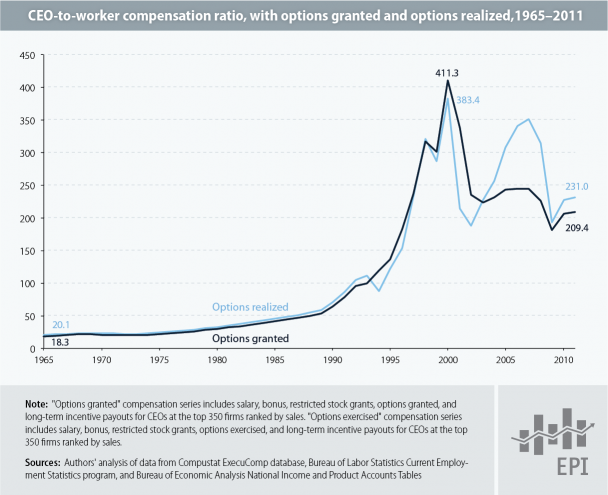
The following chart shows the
relationship between CEO-worker compensation in the form of options (H/T Greg Mankiw). Usually
executives and sometimes employees are granted stock options so the company can
tie performance to how well the company is doing. The idea is that if that
people are given stock options they will want to work hard to increase the
value of the company thereby increasing their own compensation.
Options are granted by the company
to the employee. However, the employee must wait a period of time before they
can actually exercise or have the right to buy the options. I have a feeling
many people think executives can just cash out there options whenever they want
however the board of directors and shareholders are not stupid. The employee
has to wait until the vesting period is over. The vesting period is the amount
of time the employee has to wait before he or she sells their options.
Typically the average amount of time is between 4-5 years. So really management
or employees can’t have a short term view since they can’t even cash out their
options until the 4 or 5 year period is over.
The blue line in the graph shows
the ratio between the options that were granted and when the options were
actually exercised by the employee. What is interesting is nearly every year
from 1998 to around 2003 the options or the money that employees got was
actually worth less than when they were granted. One reason for this is because
the stock could actually decrease in value which decreases the value of the
shares. Also the relative pay of CEOs increased dramatically in the 90’s and
then fell by half. I have a feeling though people will point out the factor of
how much CEOs make compared to workers. There are a couple of points I would
bring up. The first is that employees often times don’t in the same position
forever. Especially early on in their career they are trying to move up and get
a higher paying job. By moving up this would decrease the factor of what CEO’s
make compared to employees. Some people who start at the bottom of the company
reach an executive level position before their career is over. Other people may
get promotions however not want to take them due to family responsibilities,
illness, or may not want the increased responsibility and pressure. Executives
have extremely stressful jobs. They essentially spend their whole life at the
company (or many different companies). Another point that is important to point
out is that executives often pay ordinary income on their options which in
places like New York City (city, state, and federal taxes) can easily exceed
50%.
I honestly believe only a few
people really want to be executives. Everyone claims they want to get to the
top but when you look at who wants to and actually can make it to the top it is
only a very small percentage of people. Maybe next time when people complain
about CEO compensation they should first understand what it is like to be a
CEO.
Monday, May 21, 2012
Mark Holden General Counsel for Koch Industries on MSNBC

General counsel for Koch Industries
Mark Holden recently went on MSNBC and talked to Martin Bashir and was asked
questions by Bashir about Charles and David Koch’s involvement about ALEC’s
involvement in the Trayvon Martin shooting. Did Bashir think Charles and David Koch were spokesmen for the organization simply because they donated money? I thought Holden handled the
questions pretty well. Bashir really did seem to have many loaded questions
with false premises.
Many people in the media seem to
blame ALEC for the Trayvon Martin shooting when in fact. The Florida “Stand
Your Ground” law was passed in 2005 yet I
don’t remember hearing a mention of the Koch brothers from the mainstream media
until 2008. What is really curious is how is when private citizens donate to
money to a charity or organization they somehow have to agree with every single
principal that the organization or charity stands for. The same could be said
for politicians. When people vote for politicians essentially they are voting
for a basket of goods. What is also interesting is that somehow people seem to
think that the Koch brothers run ALEC, Americans for Prosperity, and Club for
Growth, when in fact these gentlemen spend the majority of their time running
the company. Yes, the Koch brothers donate money however my question would be
what percent of their money makes up all donations? Americans for Prosperity
has 1.9 million members. Club for Growth also has Thousands of Members.
I wouldn’t mind seeing Charles Koch
or/and David Koch on television for an interview to really explain their belief
in free markets and freedom. Also a autobiography would be great and really
settle many of the misconceptions people have about the Koch brothers. Of
course, both of these gentlemen are very busy. As Holden pointed out the Koch
brothers work basically every day of the work. As Walter E. Williams would say “The
rich didn’t get rich by being stupid”.
Subscribe to:
Posts (Atom)


