Showing posts with label compensation. Show all posts

Wednesday, May 30, 2012

Koch Brothers Wealth: Historical Net Worth 1984-2012


Being the researcher that I am I was curious to know what the Koch brother’s net worth has been historically. Through some painstaking research via library databases (NewsBank, Forbes, and USA Today) I found the net worth of both Charles and David Koch dating back to 1984. The chart shows the net worth of each Charles and David Koch individually and not there combined net worth. The scale is in billions. Since they own the same percentage of Koch Industries their net worth is equal every year.

The growth in net worth is astonishing. In 1984, the net worth was only $375 million each. Brothers William and Frederick also had the same net worth as well. However, over time David and Charles seemed to increase their net worth at a faster rate than their brothers. The last year I could find for both William and Fredrick Koch was 1990 when William was worth $650 million and Frederick was worth $500 million. William didn’t appear back on the charts until 2007 when his net worth was $2 billion (his net worth is around $4 billion these days). What is interesting is that William actually worked for Koch Industries from 1968-1980 and was fired. William went to go on to start his own company The Oxbow Group in 1983 and this is what helped him become wealthy. Frederick on the other hand likes to buy castles, villas, and estates which doesn’t seem like a cheap hobby.

There is no doubt that Charles and David have been superstars with increasing their net worth. On a compound annual rate the Koch brothers have increased their net worth at a rate of close to 17% per year which would outperform the S&P 500 or Dow Jones Industrial Average. What is interesting however is the standard deviation or risk of their net worth is 44%. People often talk about how well off the rich are. However, the only way they can get that way is by taking risk. In fact, I would argue they have to take above average risk in order to the place they are.  The Koch’s have a substantial part of their net worth within Koch Industries which leaves little room for diversification. On the spending side the Koch’s don’t really seem to spend that much personally.  David Koch did own a Ferrari in the late 1980’s according to this article. The Koch brothers have supported their own charitable foundations which primarily try to spread free markets and the message of limited government.

Personally, I hope the Koch brothers reach 1 and 2 on the Forbes list. Given Charles Koch is 76 and his brother David is 72 it can be said that the Koch brothers are getting up there in age. Hopefully they will continue to live a long time to continue to spread the ideas of free markets and liberty and also serve their fellow man to increase their net worth. 

Tuesday, May 22, 2012

CEO Compensation in Options 1965-2011


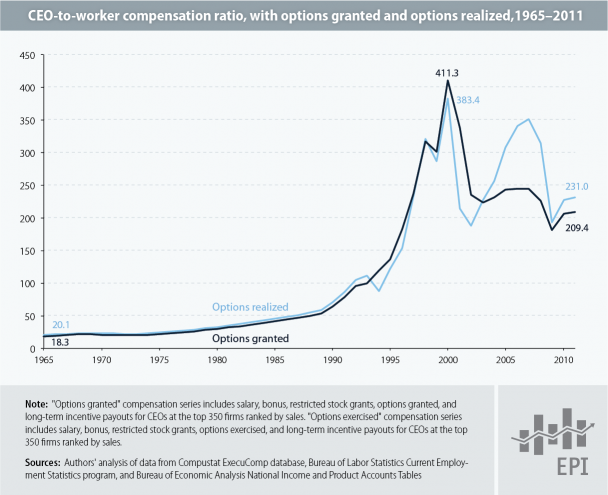
The following chart shows the relationship between CEO-worker compensation in the form of options (H/T Greg Mankiw). Usually executives and sometimes employees are granted stock options so the company can tie performance to how well the company is doing. The idea is that if that people are given stock options they will want to work hard to increase the value of the company thereby increasing their own compensation.

Options are granted by the company to the employee. However, the employee must wait a period of time before they can actually exercise or have the right to buy the options. I have a feeling many people think executives can just cash out there options whenever they want however the board of directors and shareholders are not stupid. The employee has to wait until the vesting period is over. The vesting period is the amount of time the employee has to wait before he or she sells their options. Typically the average amount of time is between 4-5 years. So really management or employees can’t have a short term view since they can’t even cash out their options until the 4 or 5 year period is over.

The blue line in the graph shows the ratio between the options that were granted and when the options were actually exercised by the employee. What is interesting is nearly every year from 1998 to around 2003 the options or the money that employees got was actually worth less than when they were granted. One reason for this is because the stock could actually decrease in value which decreases the value of the shares. Also the relative pay of CEOs increased dramatically in the 90’s and then fell by half. I have a feeling though people will point out the factor of how much CEOs make compared to workers. There are a couple of points I would bring up. The first is that employees often times don’t in the same position forever. Especially early on in their career they are trying to move up and get a higher paying job. By moving up this would decrease the factor of what CEO’s make compared to employees. Some people who start at the bottom of the company reach an executive level position before their career is over. Other people may get promotions however not want to take them due to family responsibilities, illness, or may not want the increased responsibility and pressure. Executives have extremely stressful jobs. They essentially spend their whole life at the company (or many different companies). Another point that is important to point out is that executives often pay ordinary income on their options which in places like New York City (city, state, and federal taxes) can easily exceed 50%.

I honestly believe only a few people really want to be executives. Everyone claims they want to get to the top but when you look at who wants to and actually can make it to the top it is only a very small percentage of people. Maybe next time when people complain about CEO compensation they should first understand what it is like to be a CEO.

Sunday, July 3, 2011

Corporate CEOs: Do They Make Too Much?


Once concept I have been thinking about for a while is executive compensation. The media and average person will say these people are paid outrageous sums of money even when their companies go down the drain. The only exception I actually agree with these people on was the financial bailout where CEOs were paid a lot even though their companies were bailed out by the government.


Beginning in the 1970’s companies began as part of executive pay to give certain employees stock options in order to align the same values between employees and managers. In 1992, the Securities and Exchange Commission (SEC) wanted publicly traded companies to offer more disclosure in terms of how executives were paid in order to allow shareholders more transparency. Companies before June 2005 did not have to expense stock options on their income statement. After June 2005 companies had to expense stock options or show them as a cost. Today options make up a large part of executive compensation. What is ironic however is that when CEOs were paid millions of dollars without stock options people complained because it was too much. When these people complained and said that CEOs should be paid based on how well the company does the CEOs started to make even more money and people complained even more. People seem to get upset with the amount of money other people make no matter how they are compensated.

Steven Kaplan at the University of Chicago has studied executive compensation and has some interesting data on executive compensation. Kaplan makes the important observation that when looking at CEO pay there are important things to look at. First, since such a large part of how much CEOs are paid is in stock options. Stock options are awarded to CEOs but they are not really worth anything until they are exercised. I really don’t believe people understand how executives are granted these options. Basically, executives who often have worked at the company are awarded them because they have performed well, created value, and often have been with the company more than a decade. All these are requirements just to get the stock options. On top of all this there is a time CEOs have to wait from the time the options are awarded to exercise them. Once employees are granted stock options they can’t sell them. A vesting period or waiting period is requires and this could be as little as 2 years or 10 years. Usually companies that are established have longer vesting periods since they want to reward long term behavior. So to complain and say that executives and CEOs are in it for the short term is nonsensical considering they have to wait long periods of time to cash out their stock options.

Kaplan’s research also shows that companies in the top ten percent of actual pay (not what the options were worth when granted but only after exercised) had stock returns that were 90% greater than companies within the same industry over the previous 5 years. However, companies in the bottom ten percentile in their industry saw their stock underperform 40% over the previous 5 years. So in essence what this means is that CEOs that don’t perform well will lose money since most of their compensation comes in the form of stock options. Turnover in these companies has also been increasing. In the 1970s, around 10% of Fortune 500 CEOs lost their jobs. In modern times, around 60% of Fortune 500 CEOs lose their jobs. One large reason CEOs are fired are because of poor performance. Another explanation for why CEOs are making lots of money is that the only way a company can make more profit is by expanding or adding more employees. CEOs will only add employees if they think value can be created. So as a firm grows in the number of employees CEOs are in charge of managing more resources. Research from Gabaix and Landier in 2008 showed that since the 1980s firms have increased in size by a factor of four to seven times which is the same increase in CEO pay. According to Kaplan’s data CEO pay from 2000-2007 was decreasing (I haven’t seen his data after 2007). CEOs these days are put under more scrutiny than ever before. After the 1992 rule by the SEC there was more shareholder activism and regulation regarding publicly traded companies. Sarbanes Oxley has also made CEOs basically sign their life away if there are any mistakes. It is interesting to see how many CEOs going into private equity and hedge funds as opposed the other way around.

CEOs are actually underpaid compared to people in private equity and hedge fund managers. In 2010, John Paulson earned $2.4 billion. In the same year Larry Ellison was paid $84.5 million. Or to put this in a perspective a union leader would understand a hedge fund manager is making 28 times the amount of a CEO! In fact the top twenty five hedge fund managers are paid more than the combined amount all of the CEOs in the S&P 500. Hedge fund and private equity firms don’t have to worry about the same kinds of regulation as public companies (maybe this is one of the reasons they make more).

So the case by be that CEOs are underpaid. CEOs work extraordinary hours, have to deal with burdensome regulations, have to take the blame if the company goes down the tubes. Shareholders can always vote CEOs out of their position. To think that CEOs just sit around and count their money and pick out wallpaper like I believe some people do is foolish. Firms have been expanding which explains some of why CEOs are now making more. Also the technological revolution of the 1980s and 1990s allowed CEOs to create more value. If people really believe CEOs are overpaid they should try to become a CEO so they can make oodles of money and drive down the price an average CEO can make.