Saturday, July 16, 2016

Bill Koch Thrown Out of Oxbow?/Is Bill Koch Running Out Of Money?


Update: Recently in February 2018 a court decision on Oxbow could lead Bill Koch into a forced sale of the company. The post can be read here.

Bill Koch who is usually not the Koch brother that the media follows however is one of the most interesting has recently been in the news for multiple reasons (he is for sure the most flamboyant). The most recent news story from Bloomberg is discusses how Bill Koch actually might be ousted from his own company Oxbow Energy. Bill Koch formed Oxbow in 1983 after he had an all out war with his brothers Charles and David Koch in controlling Koch Industries. Charles Koch and David essentially bought out Bill Koch, Frederick Koch, and other Koch Shareholders at $200/share. The deal after much negotiating was finalized at midnight of June 4, 1983 as I previously covered here. When the whole thing was said and done Bill Koch walked away with $470 million and Frederick Koch walked away with $330 million (Frederick never worked a day at Koch Industries!). As I write this post Forbes has Bill Koch's worth pegged at a little over $2 billion which actually seems a lot however on a compounded basis really is okay. Over a 33 year period this is only a 4% return which is about half of the return the stock market provides. Had Bill Koch stayed a shareholder of Koch Industries he could have done quite well. It should be noted that Koch Industries does have shareholders who are not active members in the day to day business of running Koch Industries (Marshall family).

The latest story from Bloomberg claims that Crestview Partners (private equity firm) is trying to get rid of Bill Koch who is CEO of Oxbow Carbon and Minerals Company. This almost seems like a reversal of history considering Bill Koch tried to get rid of his brother Charles Koch in the 1980's from Koch Industries. Crestview Partners invested some capital and took a minority ownership in Oxbow back in 2007. Under the agreement Crestview had the right for Koch to cash out his position of Oxbow. Bill Koch refused to do this and this would cause all of Oxbow to be placed on the market. When Koch opposed the quick sale it was claimed that Crestview tried to scoop up information on Koch that was not only personal but also tried to leak his business affairs to potential buyers to obviously reduce the value of the business. It should be interesting to see if anything happens with Oxbow Energy.

This leads to the question is Bill Koch running out of money? His net worth as I mentioned above is around $2 billion, however he has been selling assets the past couple of years. Bill Koch has recently been selling assets off perhaps to increase his liquidity/build his haunted town in Colorado. Currently Bill has one of his many homes listed for sale in Colorado. However, it seems as if Mr. Koch is asking too much for it as the original price was $100 million and as I write this article the price has been reduced to $80 million (20% reduction). The home is currently the most expensive home in America. The home sits on 55 acres and the actual home itself is 14,000 square feet (28 bedrooms). Not only is the whole property for sale but you can buy individual pieces of the property (the main parcels can be purchased for between $4 million and $60 million). Brothers David Koch and Charles Koch each purchased homes in Aspen, Colorado for $2.5 million each back in 1992.

Recently also Mr. Koch sold 20,000 bottles of wine for roughly $22 million. Last year Koch put up one of his Gulf Stream Florida properties homes for sale for $3.4 million. The home located at 578 Palm Way was originally on sale for $4.2 million but then had the price reduced 3 times. The home was sold for $2.75 million on February 9, 2016.  The home was only roughly 3,700 square feet with 4 beds and 5 bathrooms. Koch had his teenage daughter Charlotte Koch living in the property (she was one of the children that Koch had during an affair). Bill has not only been selling homes, wine, but has also been selling some of his artwork as well. Last year he sold 2 paintings (a Picasso and Monet) through Sothebys that fetched $100 million. Also late last year Christie's was going auction off some artwork that Bill had with the general theme being the American West. According to Christie's Koch received roughly $17 million for all his lots of artwork.

In 2013, he listed his Cape Cod property for a cool $15 million. The property located at 177 Seapult River Road as over 8,000 square feet. According to Zillow the property was sold for $8.5 million on September 14, 2014 so much less than Bill Koch was asking for. During the negotiations of Koch vs. Koch Bill always seem to put an extremely large premium on his shares.

Speaking of business Bill Koch is in the petroleum coke business which recently has been suffering due to rules from the EPA regulating coal. In this video Koch mentions that he sold 7 power plants businesses in 2000. Also he describes what Oxbow does as gas drilling, buy and resell petroleum coke (a byproduct of refining), process petroleum coke, do business in 100 different countries. Oxbow's sales are about $3-$4 billion compound growth rate 26% per year since 1984 but profits in 2014 were down 40%. Pet coke is used in coal burning power generators, either in power plants, or in the cement, iron, or steel businesses. What is interesting is that Koch Industries is a direct competitor of Oxbow Energy with their own division Koch Carbon (which Bill Koch worked for in the late 1970's however brother Charles Koch kept the file of Koch Carbon which showed it was an erratic money loser in this article).

Bill Koch in the past couple of years has raised a substantial amount of money. He announced years ago that he plans to build a haunted ghost town in Colorado which is covered in great detail here. The town is suppose to be a 19th century for a 10 acre town filled with salons, firehouse, bank, church, theater, a library, even a brothel. Koch intends for the town to be a private getaway for his friends/family (this strikes me as odd since a 19th century town would be one of the last places most people would want to visit).  The cost of the town is unknown but I would imagine Bill Koch is building liquidity to pay for the operating expenses/staff to run a whole town. When I add up the recent art, home, and wine sales of Bill Koch (I estimate he will get around $65 million for the home to be conservative) that this will bring in roughly $215 million total. If his net worth is around $2 billion this would be roughly 10% of his assets are transforming into cash. If Bill Koch has to sell part of his company that would increase his liquidity however reduce his control for Oxbow. Time will tell if Bill Koch is facing a cash shortage. However, there is no question whatever happens will be interesting as there is nothing that is boring that happens to Bill Koch.

Friday, July 15, 2016

What Charles Koch Reads on The Toilet?


Johnathon Karl of ABC News who recently did an interview with Charles Koch took this picture of the books that are locate in Charles Koch's bathroom at his Koch Industries office at the headquarters in Wichita, Kansas. I covered the readings from the Koch Industries own publication of Discovery here. I know Charles Koch is big into innovation so why doesn't he have all of those books on an iPad or Kindle!!

Big Money by Ken Vogel
Scaling Up by Verne Harnish
1920 : The Year That Made The Decade Roar by Eric Burns
The Greatest Hoax by James Inhofe
Coolidge, An American Enigma by Robert Sobel
When Markets Collide by Mohamed El-Erian
Game Changer: How You Can Drive Revenue and Profit Growth with Innovation by A.G. Lafley
Tap Dancing to Work Warren Buffett on Practically Everything by Carol Loomis
Knowledge and Decisions by Thomas Sowell
No Apology by Mitt Romney
Inflated by R. Christopher Whalen
Beirut to Jerusalem by Thomas Friedman
Jack: Straight from the Gut by Jack Welch
Scared to Death from BSE to Global Warming why Scares are Costing Us the Earth by Christopher Booker
Cool It: The Skeptical Environment's Guide to Global Warming by Bjorn Lomborg
Moneyball by Michael Lewis
The Quest Energy, Security, and the Remaking of the Modern World by Daniel Yergin
Against The Gods: The Remarkarkable Story of Risk: By Peter Bernstein
The Amateur by Edward Klein
Up From History: The Life of Booker T. Washington
I Am John Galt by Don Luskin 
The Art of What Works: How Success Really Happens by William Duggan
Ayn Rand Box Set by And Rand
Capitalism at Work by Robert Bradley
The Right to Try: How the Federal Government Prevents Americans from Getting Lifesaving Treatments They Need by Darcy Olsen
The Great Deformation by David Stockman


Saturday, May 21, 2016

J Howard Marshall, Anna Nicole Smith, and Koch Industries: The Estate Planning Nightmare

Image result for howard marshall and anna nicole smith
A while back a reporter that talked about a woman who owned the rest of Koch Industries. Right now Charles Koch and David Koch own 84% between them of Koch Industries. I always thought the rest of the ownership was owned by Koch Industries employees (board of directors/employees). However, it looks like Elaine Marshall owns around 15% of Koch Industries which puts her net worth at close to $13 billion as Koch Industries generates roughly $115 billion in revenue (according to Forbes).

Elaine Marshall was married to E. Pierce Marshall who was the son of J.Howard Marshall II (the one married to Anna Nicole Smith). J.Howard Marshall had been a shareholder for 20 years of Koch Industries. According to J. Howard Marshall’s autobiography “Done in Oil” Marshall and Fred Koch (father of Charles and David Koch) had an interest in Great Northern Oil Company which was created in 1954. Fred had founded Wood River Oil and Refining Company in 1940 which was a mid-continent oil company. In 1959 Fred Koch purchased a 35% interest in Great Northern for $5 million. According to Marshall, Fred Koch didn’t have the cash and called up First Chicago bank and Koch asked for a note in order to pay it. Koch must have had a great financial reputation to pull that off in the 1950’s.

Marshall had a 12% interest in Great Northern.  In 1959 Wood River changed its name to Rock Island (which later became Koch Industries after Charles Koch took over). Fred Koch passed away in 1966. Charles Koch had worked at Great Northern in his 20’s and knew the refinery business very well. In 1969 Koch Industries purchased a controlling interest in Great Northern Oil Company. Charles was going to purchase a 40% interest in Great Northern Oil Company but they are asking too much for it. Charles then got the idea to pool his interest along with the interest of Marshall into the holding company of Koch Financial. Charles Koch promised J. Howard Marshall a 30% interest in Koch Financial for Koch Industries. They then purchased Union Oil’s Great Northern Oil Company.

In 1974 Marshall II gave his two sons 4% of Koch Industries stock J.Howard Marshall for estate planning purposes.  He gave his sons the Koch Industries stock claiming they "are the crown jewels, take care of them". By 1980 there was a board room coup for control at Koch Industries. Bill Koch and Fredrick  (brothers of Charles and David Koch) wanted to take the company public. At the time Bill and Fredrick had a 48% ownership in the company and needed more than 50% for control. Freddie and Bill tried to purchase a 4% interest from Pierce Marshall to gain more than a 50% interest. Bill and Fredrick then approached J. Howard Marshall III to purchase his shares.

J. Howard Marshall II sided with Charles and David Koch while Marshall III was aligned with Bill and Freddy Koch. To fight off a corporate takeover by Bill Koch Charles Koch flew to California to convince J. Howard Marshall II to purchase Marshall III’s interest. Marshall II bought his son’s share for $8 million- $208/share (the shares had been gifted to Marshall III over the years). This was a large premium for Koch Industries stock considering the highest previous transaction was $80 per share. Charles Koch had urged the buyout of remaining shareholders. The buyout then lead to a lawsuit from Bill, Fred, and the other shareholders who were bought out.

In 1982 to reduce the cost of probate Marshall put all of his interests in Marshall Associates (a family partnership that held Koch Industries of which he owned 862,535 shares of Koch Industries stock). Marshall liked to use leverage though as he used 505,885 shares of Koch Industries stock as collateral. At the time Koch Industries had 5,850,908 total shares outstanding (Marshall had about a 15% interest in Koch Industries. Marshall was using the dividend income from Koch Industries stock to pay off debt and mostly to finance his lifestyle of giving generously to the ladies in his life. In 1994 Marshall earned about $8 million in dividends from his 15% interest in Koch Industries stock (1995 was a little bit less at only $7 million). This would say that Koch Industries was only paying out a little more than $53 million total in dividends in the mid 1990's when looking at ownership interests which was probably a small payout ratio as Charles Koch directed roughly 90% of the earnings back into the company for expansion.

Marshall had met Lady Walker in 1982 who worked at a strip club. J Howard Marshall would shower Lady Walker with gifts and purchased $1 million of jewels from Harry Winston and Nieman Marcus. He ended up spending $2 million a year on Lady Walker (he would spend $2 million a year on Anna Nicole Smith 10 years later). He tried to pay Lady Walker $1 million a year to handle his public relations (he tried to write this off as a business expense and the IRS said no). To impress her with his wealth J Howard Marshall showed Lady Walker a prospectus of Koch Industries with the front page reading "For Lady/The Crown Jewels". Since Marshall had purchased all these gifts for Lady Walker they are subject to what is known as gift tax (tax Form 709 has to be filed every year with this if the gift is over a certain amount). Marshall had given Lady Walker $12-$14 million in gifts without paying any gift tax on it (Marshall fired his accountant for not being aggressive enough with the IRS).  Failure to file gift tax would cost millions in penalties and fees. Marshall tried to disregard the tax code at all cost (even though he was a Yale trained lawyer).

Marshall had cut out his son Marshall III as a potential beneficiary. The stock was held in a revocable living trust (basically this type of trust avoids probate costs and also is not made public). In 1989, Marshall's first wife Eleanor decided she wanted to increase her charitable giving so she set up a charitable remainder trust. Typically this works by giving a human beneficiary income with the remainder of what is left over going to a charity.

 J. Howard Marshall retained the right to income of the living trust. In October 1991 J. Howard Marshall (who was in his 80’s at the time) met a 24 year old blond haired single divorced mother named Vickie Lynn Smith (Anna Nichole Smith). Anna Nicole Smith who was only 24 (she was a dancer at Gigi's strip club in Houston). What is interesting is because of J Howard Marshall's age he would often go to the strip club during the day and he met Anna Nicole Smith when was working the day shift. Anna Nicole talked about her job so Marshall gave her an envelope with $1,000 cash and told her she didn't need to work. Marshall would then give Anna Nicole Smith $4,000 a month for "consulting fees". Over time he increased these checks to $5,500 per month.  Of course Marshall was contemplating marriage and on Christmas Eve of 1993 a Neiman Marcus employee showed up to the home of Anna Nicole Smith to review jewelry. Over time Marshall purchased a ranch, a home, places in New York, Los Angeles, a Mercedes Benz, and jewelry for Anna Nicole Smith. Not only would these gifts be subject to gift tax but generation skipping tax (GST) due to the age difference (generally if there is more than a 37.5 year age difference in the parties and they are not related then they are subject to generational skipping tax). J Howard Marshall had a creative idea to try to adopt Anna Nicole Smith but his lawyer said that the state of Texas might frown upon that. Marshall and Anna Nicole Smith married on June 27, 1994 (son Pierce Marshall didn't know about the meeting until the day after). At the time of the marriage Marshall was estimated to be worth $500 million. What is interesting is Marshall knew that Anna Nicole had limited intelligence and called her "unteachable". Marshall created a pre-nuptial agreement giving Anna Nicole Smith $100,000 per month for each month married and $5 million if they had a child together (the agreement was 58 pages and Marshall believed that legal documents should be no more than 1 to 2 page). To his credit Marshall never planned on giving Anna Nicole Smith Koch Industries stock. I am sure Charles and David Koch were happy about this. Could you really see a former Playmate being a shareholder of Koch Industries and at board of directors meetings? Although, Marshall didn't want to give Anna Nicole Smith the "crown jewels" he did want to make sure she was financially secure which explains why he would give her monthly payments of $5,500.

Even Charles Koch noticed that Marshall showed strange tendencies during this time period. According to Koch in a 1997 deposition Marshall "tended to get drunk a lot, passed out at one of the shareholder meetings". Charles went on to say that when Marshall got drunk he tended to be pretty foolish.

Marshall however passed on August 4, 1995 at the age of 90. From 1994 to 1995 Koch shares appreciated from $664 million to $780 million. J. Howard Marshall in 1994 transferred $6 million of gifts (including ranch, several houses, cars, jewelry, and a substantial amount of cash) to Anna Nichole Smith. While Marshall and Anna Nicole Smith were dating he would pay her a $4,000-$5,500 per month consulting fee. Because they were not married this amount would be subject to gift tax (if you are married you can give an infinite amount under the marital deduction). When Marshall and Anna Nicole Smith were getting close son Pierce Marshall attempted to shift ownership of Koch Industries around from. This 1999 New York Times article speculated that Anna Nicole Smith (who was only 31 who was a high school drop out) "could become one of the richest women in America". At the time the Marshall family owned 8% of the voting stock for Koch Industries and 16% of the non voting stock. Anna Nichole Smith had issues handling money as in 1996 she filed for bankruptcy (she listed the inheritance from Marshall-who died in the year prior as an asset). Smith had claimed that Marshall promised her half of his $1.6 billion estate. In 1999, a California court awarded Anna Nicole Smith $400 million but then in 2002 a federal court reversed that award. Daniel Fisher of Forbes wrote a good article and timeline of the court cases here. In 2014, a court rule that one of Anna Nicole's children Dannielynn would not inherit the $49 million of the Marshall estate. In essence Koch Industries will not transfer to any new beneficiaries.

The whole J Howard Marshall estate is a very good case study for estate planning. The Marshall family is still one of 9 shareholders of Koch Industries stock. Elaine Marshall and her family still owns about 15% of Koch Industries stock. Bloomberg uncovered Marshall as a billionaire. Bloomberg pegged Marshall's net worth at $13 billion however according to this article a spokesperson said the valuation is inflated. They actually do have a point since Koch Industries is privately owned the valuation is the same as valuing a public company such as Google or Microsoft. Elaine Marshall is 73 years old (younger than Charles Koch). She has two sons one named Preston Marshall (grandsons of J Howard Marshall) who is an oil executive for MarOpCo in Houston. It is said that Preston Marshall is the largest shareholder of Koch Industries outside of Charles and David Koch. Why isn't he on the billionaire list? The other son is E. Pierce Marshall Jr. who works as a Vice President for MarOpCo with his brother and also runs a family office called Elevage Capital Management in Dallas. J. Howard Marshall would be proud as E. Pierce Marshall Jr graduated from Yale Law School in 1995 and received a business degree from Tulane (where he sits on the board)

What is quite interesting is that J. Howard Marshall and Anna Nicole Smith were only married for 14 months and the battle for his estate extended for a mere 20 years. 

Monday, April 18, 2016

Economic Basket Case of Venezuela


For some time I have been fascinated with the economic/political situation in Venezuela. The country for years has lived under a socialist regime which I believe has lead to a major decline in the standard of living (and unfortunately the death of many people). Recent stories about the situation in Venezuela made me want to write this blog post.  If you examine the history of Venezuela you will find that the country has never embraced capitalism or free markets. This mindset will continue to drive the country off a financial cliff and ultimately will have disastrous consequences.

Venezuela has a history of not having its act together. In 1875, the finance minister said "Venezuela does not know to whom it owes money and how much. Our books are 20 years behind". During the 1970's Venezuela saw a large increase in the revenue from oil. It was at this time that President Carlos Perez instituted the "The Great Venezuela". The program spent $2 billion and lead to corruption and the state ended up owning 300 companies (none of which made any money). By 1997, it was estimated that Venezuela had blown through $100 billion in oil revenue in the previous 25 years (this makes trust fund kids look frugal). In December 1998 Hugo Chavez was elected president of Venezuela. The economic freedom after Chavez took office declined dramatically as can be seen in this graph. However, this is despite the fact that the country under Chavez brought in $700 billion of revenue (most of this was redistributed to social programs) Like any politician he promised to improve the current situation (fighting poverty, eliminate corruption, and keep the country safe). As Chavez took over the debt increased from $22 billion to $70 billion. The debt situation now is so bad that the country is shipping gold instead of paying cash for debt payments. In 2016, the country will have to pay back $10 billion in debt. Venezuela also became one of the most dangerous countries as well with a murder rate of 82 homicides per 100,000 inhabitants (for comparison U.S. is about 5 per 100,000). No one with a brain even goes out at night in Venezuela. What is even worse is 98% of the crimes in Venezuela don't result in prosecution.  After Chavez passed away in 2013 Nicolas Maduro took over. The country recently ranked #1 on the Misery Index. The country also has a low Freedom Index score as well.

The modern day situation of Venezuela is pretty grim. Price controls of many goods have led to shortages nationwide. The country has had shortages of food, medicine, power (the country tried to have their own day light savings time to reduce the amount of energy consumed-I doubt this will work), dirty water, even shortage of tampons! Currently 80% of the people of Venezuela are below the poverty line. As you can see in the pictures there are stores with empty and bare shelves (symptom of price controls). Some people have used cooking oil to pay doctors. Food shortages have reached 85% and medicine 96%. This YouTube video shows how social media is used to basic goods (the same goods are available at any small convenience store in the United States). What would Americans do if this happened?

The government of course blames "greedy companies" for all its problems. The country typically takes private property from large companies and uses it to build its own social purposes. However, anyone who has taken basic economics knows that price controls create shortages. The past week people can't even find toilet paper and phone companies are suspending long distance phone calls. The healthcare system is also crumbling. Hugo Chavez promised that healthcare was a right and should be free. Simple drugs like aspirin, antibiotics, and insulin are scarce. Only 36% of the beds in Venezuela hospitals are in operation. People go on to Twitter and Facebook and try to see who has what drugs. Around 70% of people in Venezuela stopped buying basic food because it took too long to find or was too expensive.

The country has seen a step decline in oil revenue from $37 billion in 2014 to only $12 billion in 2015. The country has seen rapid inflation too. The country is expected to have inflation of over 700% this year! Last year the economy shrank almost 6% .The debt rating is CCC from Standard and Poor's  (this means the country has a good chance of defaulting on debt in short period of time). This means that if something were to cost $1 in January by the end of the year it would cost over $8.

The solution for Venezuela is a multi step one that won't happen overnight. The first step would be for the people to throw out who is currently in office (currently trying to take place here) and elect people who will not jail political opponents or anyone else who disagrees with them. Current President Maudro claims that "no one is going to kick [him] out". The next step to reform is to enforce property rights and to privatize all the industries that the country owns. Privatization will lead to efficiency, accountability, and more peace (as trade involves the act of voluntarily cooperation). Companies don't want to do business in countries that are run by dictators who can seize their property at any given moment. If property rights were honored companies around the world would come back to Venezuela to do business. The next step would be to end the price controls of nearly every product which would eliminate the shortages of nearly every product. The mix of private property rights, privatization, and eliminating price controls will create competition, more products, and no waiting lines. The country relies on the oil revenue for about 40% of their government revenue. The oil price that Venezuela needs to balance their budget is about $117/barrel (currently as I write this oil is below $40/barrel). Massive trade liberalization (remove trading tariffs/barriers) would invite more trading partners around the world. The country has revenues of about $143 billion (2014 estimate) but spends $204 billion. This path of overspending can't continue forever. Venezuela needs substantial reforms soon before it falls off the cliff. The country is a perfect case of how socialism does not work.


Wednesday, March 30, 2016

The Case Against the Department of Labor (DOL) Fiduciary Rule


In my regular day job I work for a registered investment advisory firm (RIA) and provide comprehensive financial planning advice to clients. So most people don't know but the Department of Labor has proposed a new fiduciary rule that would put even more restrictions on an industry that is already highly regulated. Let me explain the current regulatory state of the financial industry before getting into the current proposed rule.

Currently, people in the financial industry are subject to various rules and regulators (depend on where they operate/size of the firm). An overview of the rules can be found here (60 pages worth-just a summary remember). The actual Securities Act of 1933 is 93 pages which can be found here. The Securities Act of 1934 can be found here which is only 371 pages. ERISA is another law that governs investment advice as well (especially for retirement plans). A summary of ERISA can be found here which is 76 pages (this is just the summary too). The actual ERISA law can be found here which is 460 pages! Clearly, people who claim the securities industry isn't regulated need to look at the data. Let's point out really what the rules are trying to protect against is fraud which can be dealt by contract law (breach of contract).

Right now there are two type of business models in the financial planning world. The first is the brokerage model which essentially is a company like Morgan Stanley/Goldman Sachs/UBS etc. These companies are under what is known as a suitability standard which just looks at a client's situation and looks at their unique characteristics and a product is recommended (i.e.-in practical terms this could be anything). The way people may money under this model is by selling a product with a commission. The commission can vary by the type of investment the broker recommends. Typically a brokerage firm will recommend Fund XYZ and then get a cut of the action from the fund company for marketing the fund (this is known as a 12b-1 fee). Let's not forget other professions like car sales people, real estate brokers, and insurance agents are compensated in similar ways. Also it is important to point out that the general public is aware this.

Brokers are required to take the Series 7 exam which is about 260 questions and a 6 hour exam. Also what is even more interesting is that let's say you are in college and want to get a head start on the Series 7 exam, you can't take it unless you have a brokerage company sponsor you (barriers to entry). If you want to provide any type of financial advice you have to take the Series 65 (I actually took this exam a few years ago) and the test is a 155 questions, takes 3 hours, and is $155 (again you can't take this exam unless a firm sponsors you-which makes very little sense).

The other type of model is the fiduciary model (I work in this realm). The fiduciary model is were the financial advisor places the interests of client ahead of their own.  Typically these firms seem to be more comprehensive and will look at the whole financial picture (investments, taxes, insurance, retirement planning) as opposed to just investing a brokerage firms do of just buying and selling securities for clients. On average RIA's charge a fee for the amount of assets they manage (which can range from about 2% to .4% depending on how much a client has under management). People are not paying for just investment advice but for comprehensive planning to try to integrate everything. Some firms charge hourly rates or project rates for certain things. In recent years there have been complaints that RIA firms only cater to high net worth clients (typically these firms have minimums they require to become a client). RIA firms still have compliance requirements such as filing an annual ADV form (from personal experience these are time consuming and provide little to no value as clients never look at them and if they have a question contact the advisor anyways). However, recently a network called XY Planning Network that targets younger people who may not have enough assets to work with other advisers and some in the network just charge a monthly fee/per hour fee for planning (market forces working).

The fiduciary rule (actual rule from the Department of Labor can be found here and the over 3,000 comments can be found here would ban investment advisors from charging commissions or charge a higher fee (percentage of assets under management) if a client rolled their 401k plan over to an IRA. Typically once clients retire they have assets in their company 401k. These assets are rolled over into a separate IRA (as this retains creditor protection). Advisors can charge a higher fee or commission if they get a client to sign a best interests (contract). If the contract is signed then the advisor can charge the higher fee. The idea is to get advisors from recommending products with high commissions (such as variable annuities/non-traded REITS) which can generate a good income for an advisor who recommends them but may not be best for the client. Of course, anyone with any common sense could ask the question of how the advisor is getting compensated. Clients always should ask questions about the products they are purchasing. As a result advisors will have to disclose how much they are making which of course will cause clients to leave and go elsewhere. Of course these clients won't have enough to join many RIA firms (most of these firms usually have minimums before they can take on clients). However, even I was surprised to learn that Edelman Financial services will work with clients who have as little as $5,000 (again market forces at work). Although, I would be curious to see if this amount increases if the fiduciary rule is passed.

RIA (registered investment advisors) firms have grown in the past number of years (again the free market at work). Between 2013 and 2014 over 2,000 RIA firms were started.  There are roughly 32,000 RIA firms in the United States. There is no surprise that RIA firms have been taking assets away from brokers (also known as wirehouses). RIA firms held about 23% of the assets under management which grew after the financial crisis. Median assets for RIA firms increased 67% from 2009-2013. Consumers are voting with their assets and have been migrating to RIA firms even before any type of legislation was passed (legislators are you listening?

Also with the use of technology many advisors can meet with clients virtually it doesn't always have to be in person. A technology known as robo-advisors have come online the past few years. Robo-advisors will rebalance investments to get clients to were they should be by automatically trade for the client (takes human emotion out of it). Also robo advisors typically invest in low cost index funds (which for young people who are trying to accumulate wealth are perfectly fine). As of December 2014 robo-advisors had about $19 billion in assets (this figure is continuing to grow). Companies such as Betterment and Wealthfront can manage your money for very small fee and does the trading for the client (taking the broker out of the picture). Although, robor-advisors haven't had type of serious market correction (like in 2008) to test themselves.

The problem with the fiduciary bill is it will add additional paperwork for clients (there is already of plenty of paperwork that clients have to sign/agree to on a regular basis). Brokers who usually get paid on commission will switch to a fee-based model which will end up costing even more than the commission based model on a percentage meaning consumers will pay more and try to seek out a registered investment advisor (many of whom probably won't take unless they have a minimum amount of money), or even worse consumers will try to invest money themselves which is probably the worst scenario. For example if someone has a $100,000 account and they purchase something that has a commission of $100 that represents only .1% cost. Now if the advisor after the fidicuary rule moves to a fee based model and charges 1% the client would have to pay $1,000 (10 times the amount of the product they purchased!). When Great Britain banned commissions smaller investors/general investing population were forced out. I would predict the same will occur after the passing of the fiduciary rule.

Regulation isn't needed for a fiduciary rule when consumers are already voluntarily moving money from broker dealers to registered investment advisors/robo-advisors without the force of government. If anything there should be a reduction in regulation in the financial sector. The Securities and Exchange Commission, FINRA, Securities Act of 1933 and 1934, ERISA, and state regulators all play a major role in the current regulatory state. People forget that stock brokers and financial advisors can't lie about the products they sell (this is known as fraud and we have laws against that). My prediction is the fiduciary rule will add substantial compliance costs, reduce people access to financial advice, and make the average person worse off. Economist Robert Litman did a study showing that the cost of the fiduciary rule would be $80 billion. These costs will be passed on customers. Add to this, Litman estimating that about 7 million will be shut out of advice with the fiduciary rule. I would ask the creators of this rule what are they trying to correct when many people and billions of people have gone from brokers to registered investment advisors (RIAs) and robo advisors?

Saturday, January 2, 2016

A True Free Market Libertarian Approach to Health Insurance/Medical Care


Many people have lamented over Obamacare (even some Democrats). Republicans in a way to counter Obamacare have offered very sparse and generic reforms such as "allow people to buy insurance across states" and "health savings accounts". I divided the post into a few parts: the problem and go on to discuss what causes the problem of high medical prices and then offer some solutions that could be used to reduce the cost of medicine, allow more access, and improve the quality.

The Problem
The reason healthcare is more expensive is because individuals are not directly paying for the services rendered. People have little incentive to shop if the government or an insurance company is paying most of the bill. Between 1960-2009 the percentage of consumers who directly paid for healthcare expenses dropped from 48% to 12%  while the percentage that government paid increased from 24%-48%. The government in this report seems happy that improper Medicare payments are only 10% of the budget. During the same year (2013) Medicaid only made improper payments of $14 billion of improper payments. Why would any one trust the government when it comes to healthcare when the government misappropriated payments from Medicare, Medicaid, and other tax credits that totaled roughly $125 billion.

When you go to Wal-Mart, Amazon, or McDonald's you see a price posted and you can either purchase the item or leave. As University of Chicago professor John Cochrane points out in this excellent essay "the Cheesecake Factory delivers a complex service oriented business product with remarkable quality, efficiency, and cost. Why can't hospitals do the same?"

What Did We Do Before Health Insurance?
Before insurance companies ever existed there were such things as mutual aid societies were individuals essentially form their own insurance company by getting groups of people together and each contributing about $2/day (which was the wage for a day of work). Let's not forget people in the early 20th century worked more hours than people do these days. During the 1920's the value of these societies was $9 billion. Mutual aid societies could limit who was in their group (insurance companies have to take on anyone who applies). What is even more interesting is that the mutual aid societies had a 30% lower mortality rate than the general population!  The government of course didn't approve of this and in 1919 passed the Mobile Law which increased the reserves that mutual aids had to keep, required a doctor to examine all lodge members, and the lodge couldn't extent credit to members. Slowly over time the government increased the regulations which reduced the importance of a voluntary market for health insurance. If me and a couple of friends want to form an insurance pool why should the government stop us?

Health Insurance Problems-Deregulate this market
With Obamacare health insurance companies are subjected to medical loss ratios. This ratio essentially dictates how much health insurance companies can spend on medical care from the premiums they collect. Currently the ratio is 85% which means that if there is $100,000 paid in medical premiums at least $85,000 has to be for medical care. Essentially this rule came about because people believed that insurance companies were greedy (remember insurance companies make less than a 4% profit margin) and that insurance companies will only spend their money on advertising and marketing to try to lure customers in. However, the flaw with a medical loss ratio is requiring a health insurance company to spend 85% of the medical premiums on health care it creates incentives for health insurance companies to overspend since the insurance company is required to spend the money within a one year time frame. This incentive leads health insurance companies to spend more on the latest technology (MRI machines, CT scans, etc.)

Community rating laws are another form of regulation that essentially say that everyone that buys health insurance even though people vary in: age, sex, height, weight, lifestyle. The only thing that health insurance companies can charge different prices for is whether or not a customer is a smoker Community rating laws only exist in health insurance. Car insurance companies can increase your rates if you are younger and more reckless but not health insurance companies. If you look at what insurance at companies are required to cover this also drives up the cost of health insurance. For instance, health insurance plans must cover things (a list of 10 things here)  mental illness, lab tests, preventive and wellness service, maternity care, and many other things. Why can't we customize our health care plan to our own needs? Speaking of that under Obamacare policies have unlimited lifetime limits (meaning there is no maximum dollar amount your policy can cover). Why not allow there to be a market to allow people different amounts of lifetime coverage ranging from $50,000 to a couple million?

Looking at the health insurance market the market itself is not itself competitive. All insurance companies (whether it be health, auto, life) are first regulated at the state level. Usually every state has their own insurance commission. Health insurance companies have to abide by risk based capital requirements which looks at the assets of the insurance company to make sure they have enough of a surplus. Also another thing that state regulators look at are the insurance financial statements to make sure the insurance are financial solvent. On a regular basis state insurance department audit health insurance companies. There are also rules regarding how much health insurance can increase premiums at the state level. I looked up the rules for how to incorporate an insurance company in Texas and realized that it is a long 14 step process. First there is a filing fee of $1,500. Also you need $700,000 of a capital surplus ($1.4 million capital and surplus combined). You also have to make an SEC filing and file GAAP financial statements which take time and are costly. Also the insurance company must have 5 board of directors as well (oh the state of Texas doesn't allow anyone with a felony conviction involving moral turpitude to serve on the board of directors too).

Another no brainer is to allow customers to purchase health insurance across state lines. States have their own rules and regulations in regards to what has to be offered inside a health insurance plan. The state is not only in charge of what contained in the plan but also how much the health insurance plan can charge (health insurance companies must get approval before they even offered to consumers-nothing close to a free market!). While we are at it why don't make it easier to start a health insurance company. How many health insurance company IPO's have you heard of in the last 15 years? I actually did find one company called Oscar in this article that is trying to provide a cheaper model for health insurance (the company of course had to get state regulatory approval before it opened up shop-the company was the first new health insurance company to open in New York in more than a decade!). .

FDA Drives Up Drug Cost and Prevents Patients From Accessing Drugs-Limit Their Scope
There are many things that increase the cost of health care. One organization that increases the price of drugs is the FDA. The Tufts Center Study of Drug Development estimates that the cost of developing only one drug has increased from $100 million in 1975 to $1.3 billion (both in 2000 inflated dollars). Avik Roy from Forbes here points out there 90% of the costs associated with a clinical trial is in last phase of the clinical trial-Phase III). Not only did it become more expensive to develop a drug it also took longer (from 1999-2005 the length of the clinical trial time increased by 70%) and the number of patients required to enroll has more than doubled from 1,600 in the late 1970's to 4,200 in the 1990's) but the number of procedures that patients had to receive (blood work, x-ray, etc.) from 1999-2005 increased 59%. Also the chances of a drug getting approve have also been decreasing. The trend of approval of new drugs which can be found here has been on the downtrend since 1996.

When was the last time you  heard of a large drug company going public? No one in their right mind would want to start a large drug business given the burdens of the FDA. The FDA also doesn't factor in that everyone has different biology and if two patients take the same treatment they will have different outcomes. However, in practice what the FDA does if a drug doesn't show a statistically significant benefit in a trial then a company isn't allowed to sell that drug-even though some patients in the trial benefited from the drug. The FDA should only have one phase for drug development (to see if a drug is safe) to reduce the time and cost of developing a drug which would allow more patients access to treatments at a lower price and allow patients/doctors/researchers to see if a drug can benefit people who take it.

Speaking of medical tests what is bizarre is that if you want to get any type of medical test you usually need to have a doctor tell you that you need it. You can't yourself show up to Quest or Labcorp and say you want a blood test. Arizona this year passed a law that allowed patients to get a blood test without the prescription of a doctor. According to this article from Bloomberg companies are now being more open to offer customers testing for different things like cholesterol and thyroid. It is silly and crazy to not allow people to get tests performed on their own bodies! Theranos is a company trying to work on providing patients with access to medical test for affordable prices, however the FDA recently questioned some of the equipment that the company was using.

Government Regulations in Healthcare
According to this article about 51% of healthcare professionals say HIPPA compliance gets in the way of providing care to patients. Healthcare professionals waste about 46 minutes a day using outdated technology due to HIPPA regulations. This is 46 minutes that could be used with patients not filling out paperwork. Doctors very rarely use e-mail/smartphones/computer or other forms of communication to talk to patients due the restrictive nature of HIPPA which requires burdensome rules and requirements in terms of maintaining patient privacy. In a survey 65% of doctors said that secure text messaging could cut discharge time by 50 minutes. Why would doctors have any incentive to e-mail or text a patient when insurance companies pay $0 for that.

Certificate of need laws also restrict access to medical care. If someone wants to bring a medical facility to a city they must get approval from the city and state before they do so. These laws results in fewer hospitals beds, fewer CT scans, and fewer MRI services according to this study. For instance in South Carolina Policy Council reports requires that 20 different medical services and pieces of medical equipment currently require certificate of need laws. Also in South Carolina the government has to approve any new medical services (i.e. expanding the size of a healthcare facility or purchasing medical equipment costing more than $600,000) according to this report.

The government has created an arcane code system that determines how doctors charge. This system is called CPT codes. Nearly every medical procedure that can be performed has some code associated with it. The government is up to CPT coding version ICD-10 which features more than 14,000 codes "prices". The American Medical Association (AMA) is for CPT coding (of course they collect a fee every time a CPT code is used).  This surgeon explained the problems with CPT coding here. The problem is that doctors have to figure what a bureaucrat wants instead of using common sense and simply just charging a cash price. Is it a bad thing to get doctors to determine what value they provide and charge for it instead of using a bureaucratic table to see how much they can collect from a code? I am all for turning doctors into business people. Why don't we ever see hospitals have commercials for patients to have there next back surgery for only $599? CPT codes should be abolished as they are just another form of price controls and central planning.

Speaking of restrictions why have historically there are fewer medical schools now than in the early 1900's? As I mentioned in this post  in 1903 there were 154 medical schools. As I write this there are 141 accredited medical schools in the country. The knowledge of medical data has greatly expanded in the past few decades.Why don't we have more medical schools given that the population has greatly expanded?

Some Solutions
Doctors have gotten tired of dealing with insurance companies and the establishment of medicine and have decided that they will stop taking insurance altogether and deal with patient directly (what is known as direct primary care or concerning medicine). About 6,000 doctors (from 2014) contract directly with patients. Currently about 7% of doctors are currently using direct primary care and about 13% plan to transition to it. Patients still retain their insurance in case they have to be hospitalized or have something serious like cancer (which is the concept of insurance). The average membership fee is $135/month which provides 24/7 care and lets patients e-mail, call, even text their doctor. According to the this New York Times article doctors typically spend 8 minutes with a patient. patients get 30, 60, or even 90 minutes with a doctor for a more comprehensive review of their health situation. Not only are these type of practices popping up in major cities but also in cities like Waco, Texas (less than 130,000).

People these days can look up the quality of a doctor in a matter of seconds through Yelp, RateMDs. HealthGrades, Vitals and many more sites to assess whether a doctor is providing quality or not. If we take this one step further to a true free market a company called Medibid allows patients to bid on their medical care. The Surgery Center of Oklahoma offers its cash prices online. Why don't we ever see advertisements for the cash price of a hip replacement?

Making profit in medicine is not a bad thing. As I pointed out in this blog post Dr. Devi Shetty in India not only has an actual business in medicine were there are cash paying customers who pay and he is still to provide medical care to lower income individuals while also turning a profit (pre-tax profit margin is around 8%. In 2015 the company made a profit of $2 million. Also Dr. Shetty performs double the number of surgeries as the Cleveland Clinic and has a lower mortality rate of 1.4% vs. 1.9% for the United States). The company performs an average of 150 surgeries per day  It is important to note Dr. Shetty figures out what supplies are necessary to perform surgery and he closely examines the cost of everything to see if it makes sense, His company Narayana in India recently filed with the Indian version of the SEC trying to raise $100 million. In 2015 the company served more than 2 million people. We have to understand that profit in medicine is not a bad thing. If a doctor can improve our quality of life, make us feel better, and help us enjoy our time on this earth they should be compensated. Why we can't have hundreds of these set up in America?

Conclusion
It is no coincidence that as the percentage of people paying for their medical expenses out of pocket has decreased while the cost of medicine has increased. What we need to do is return to a system were anyone can create a mutual aid group or their own insurance pool without being subject to the regulations of insurance companies (this would actually increase coverage and reduce premiums). Speaking of regulations repealing the laws and rules surrounding insurance companies and create more companies which would reduce the premiums and increase quality. Also reducing the number of phases for a drug trial from 3 to 1 (safety should just be evaluated) drug approved would reduce the cost to develop a drug (which drug companies would pass on to consumers) and also give consumers years earlier which is crucial when some people have life threatening/chronic illnesses. Abolishing CPT codes and allowing patients to negotiate prices for medical services would put downward pressure on prices and doctors would be forced to think about how much their services are worth. Repealing medical loss ratios rules would also not force insurance companies to blow through the premiums they receive in a year and give insurance companies incentives to hold on to their premiums for longer than one year. Restricting certificate of need laws would also allow more  Also severely reducing HIPPA rules could perhaps get us in 21st century medicine (it is bizarre that my doctors still have to fax things!). Massive deregulation in one of the most regulated industries would greatly free up the medical industry to innovate while providing people with more access to health insurance and health care at much more affordable prices.

Saturday, October 10, 2015

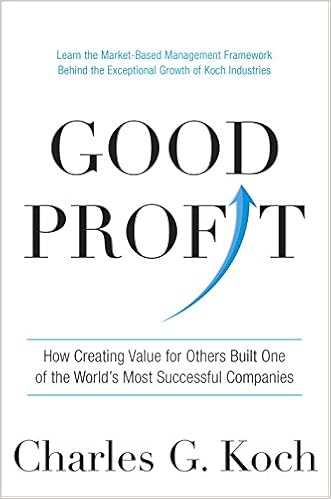
Charles Koch and "Good Profit" Book Review/Summary


Well October 8, 2015 I looked out on my doorstep and saw a package from Penquin Publishing and was surprised that I received Charles Koch new book "Good Profit". The book had on it uncorrected proof/not for sale on the front cover and the book. Also the copy I received ended up being 250 pages as opposed to the 288 pages for the final version. I have covered Koch Industries for years as I have written about the estate planning/succession planning here and even talked about the daughter (Elizabeth Koch) here. Of course any blog post I have written can be found here. I ordered the book from Amazon back in March 2015 but I guess I got the book earlier then the release date of October 13, 2015.

As soon as I got the book I couldn't put it down. What is nice about the book is that it is written with more of a personal side of Charles Koch and his family. Throughout the book stories, anecdotes, and analogies are used to get across the points Koch tries to make. For instance Koch in his free time likes to read praxeology, golf, work out, and eat heart healthy meals. The book mainly is about how Koch Industries operates and its history (both the good and the bad) is a great look into how Koch Industries truly operates and what Market Based Management (MBM) is truly about which has led Koch Industries to tremendous growth sine 1961. The company in 1961 was valued at $21 million and now in 2015 is valued closer towards $110 million (27 times better than an investment in the S&P 500-assuming dividends were reinvested). The company plans to grow 12% per year for the continual future. During the 2008 recession Koch increased doubled its shareholder equity and increased its workforce by 40%. The book emphasis the five dimensions of MBM which are Vision, Virtue and Talents, Knowledge, Decision Rights, and Incentives.

What I think readers willl find interesting is that Charles Koch didn't begin out as a Libertarian he read the "entire political spectrum from "left" to "right" and everything in between. This means he even read John Maynard Keynes, Karl Marx, and Vladmir Lenin. Two books for Koch that ended up being life changing were Mises Human Action and F.A. Harper's Why Wages Rise.

Charles points out that growing up Frederick Koch (the oldest son) wasn't one for physical labor. Since Fredrick Koch didn't develop a work ethic Fred Koch was harder on Charles Koch making him work at age 6 and made sure work occupied most of his time. Koch writes that even at age 79 he still works 9 hours a day.  His work history started out digging dandelions and then went on to bail hay and milking cows. In high school Charles was working on the ranch fixing fences, digging ditches, shoveling wheat in a grain elevator. Growing up Charles wasn't easy to deal with and attended 8 schools by the time he graduated high school. During his junior year he got thrown out of Culver Military Academy for drinking beer on a train). One summer Koch has so much homework he would wake up in the middle of the night and sight on the shower bench in the communal bathroom to finish it. Charles improved and was accepted into MIT. While at MIT Charles was maintaining a B- average (he was majoring in engineering too/enjoying himself having a social life) when he came home for summer break is dad told Charles that he would only pay for his education if Charles fully applied himself. After this talk Charles improved his grades a full point. After Charles graduated he went to work for Arthur Little were he designed a plant that produced a potent marijuana derivative. It was after father Fred Koch passed away that Charles Koch took the reins at Koch and growing it by leaps and bounds.

The personal side of Charles Koch is somewhat interesting he from an early age was a trouble maker and sometimes got into fights. You can't be an entrepreneur playing follow the leader. Charles once had a heated debate with a girlfriend of David Koch during the 1960's when she was taking views that the government should run people's lives. This girl mentioned that the government should act however the majority wanted. Charles most likely got frustrated and asked her if she was a redhead (knowing David he was probably dating a brunette or blonde) and the majority of the population voted to kill redheads would she be in favor of that. The girl started crying and even cried the next day which Charles still remembers after 50 years when it happened.

When it comes to subsidies Charles Koch is against all forms of corporate subsides. Koch for years has been against ethanol mandates (this actually increases the cost of food for the least advantaged people). Koch dispels the myth that Koch would profit from the Keystone Pipeline. He write that Keystone would increase the cost that Koch pays for crude by $3 per barrel which would lower Koch profits by $260 million per year. However, Koch takes the position that the pipeline in the long run would be better for the economy as a whole even if the company loses money from it.

Charles Koch is open and honest about the successes and failures of Koch Industries. In 1974 Charles Koch and his wife Liz Koch were breaking ground on their first home. During this time Koch Industries had to deal with price controls, the Arab oil crisis worried Charles that Koch Industries would go bankrupt. Charles Koch also discusses the 1996 pipeline leak that killed 2 teenagers Texas. Koch reflects openly and honestly how that incident along with a few others changed the company view about safety. It was after this incident that Koch switched to a 10,000 percent compliance (100% of employees acting in compliance 100% of the time). Koch discusses how the company when it had dramatic growth it had internal fraud issues were employees were setting themselves up as vendors, taking inventory, and receiving kickbacks which Koch quickly shut down.

Overall the book is well written and easy to read and includes a personal side of Charles Koch not seen before-like the 153 death threats he got in 2014. The book discusses how Koch has grown tremendously since the 1960's (Charles didn't simply inherit the company as some might say). The company has grown so much by reinvesting 90% of their earnings back into the company. What is interesting is how Koch Industries despite having 100,000 employees doesn't appear to be bureaucratic and individuals are always asked to challenge and consider continuous improvement which sometimes never occurs at even Fortune 500 companies. Overall the book is a mix of economics, business, behavioral finance, philosophy, and good story telling of business failures. What I enjoyed was Charles Koch is honest about his failures. Koch is apply to apply Market Based Management to every day examples (including the NFL and even how much time he should spend working editing grammar of the book he wrote). The book is really a great book for anyone who wants to try to live there life to their maximum potential.

Sunday, September 27, 2015

In Defense of Martin Shkreli (Blame the FDA)


So this past week Martin Shkreli who is only 32 years old but is CEO of Turing Pharmaceuticals. announced an increased in a drug called Daraprim which is used to treat toxoplasmosis (parasitic disease), malaria, and AIDS from $13.50 per pill to $750 per pill which represents a 5,455% increase. After public outrage a few days later Martin then announced that they would lower the price of Daraprim. This Slate article describes how if only the FDA had more funding and the government had more control we would see lower prices (in other news pigs fly).

In 2014, only 8,821 prescriptions for the Daraprim were written. According to the CDC there are between 400-4000 new cases in the United States every year and roughly 750 people a year die from it. Also toxoplasmosis can largely be prevented by cooking meat at the right temperature.  I have heard the common argument that the costs to make one pill is less than $1, however people who make this argument are not including distribution costs, FDA regulatory costs, and manufacturing costs that are not included in the marginal cost of less than $1.

According to SEC filings Turing Pharmaceuticals purchase the drug for $55 million in August 2015. The total revenue of Daraprim was about $5 million last year which is hard if not impossible to make any profit. At the previous price of $13.50 there was no one making a profit for it. The CEO claims the company will use their revenues to reinvest in developing a better with side effects. Parasitic diseases can rapidly change and a company needs to perform the research and development now in order to combat future mutations. According to this report death was reported in about 4% of patients who took Daraprim. Some patients have reported vomiting, renal failure, and Stevens-Johnson syndrome. All drugs have risks but the question is can the reward-risk profile can be improved.

It is important to distinguish the market price versus what people actually ended up paying. Even the CEO said that 50% of the customers pay less than $1 for the drug (which in this interview the CEO says in a major impediment to making money).  In the original New York Times article a director of toxicplasmosis at the University of Chicago praised the company for delivering the drug to patients quickly and most of the time without charge. In essence the price that people pay is somewhere between $0-$750/pill even though the stated price is $750 per pill. The company also participates in the 340B Drug Pricing Program which guarantees that Medicaid patients and hospitals get the drug at a reduced price. Alex Tabarrok points out that the prices in India are only going for 5 cents a pill compared to $750 in the United States. Perhaps some capitalists in India could sell their supply to people in the United States for less than $750 in order to increase the supply of Daraprim which would also bring down the price.

The FDA has a burdensome process for not getting a regular drug approved by also even a generic approved. Remember drugs have to first get approved by the FDA which can cost roughly $2.5 billion and take 10-20 years to develop from the research stage to actually being available to the patient. Approval times have only been showing too. In 1960 the average time for drug approval was 3 years and then 6 years by 1965. Companies have between 5,000 and 10,000 substances that they try to turn into the next blockbuster drug but 80% will lose money.

After a drug has been approved it then usually has a patent life between 7-12 years. After this period it then becomes what is known as a generic. Once the drug becomes generic other companies can begin making the drug and as a result the price drops about 30-80%. Even though the drug company spends roughly $2.5 billion bringing a drug onto the market (liberals dispute this figure however they don't understand their is an opportunity costs in dealing with the FDA when they are slow to approve drugs and raising capital) and 10-20 years bringing the drug to market if it wants to make a generic it still has to file an application with the FDA for approval. This whole process of getting the initial drug approve is known as NDA (New Drug Application). When a company is going through getting a drug as a generic it files a ANDA (Abbreviated Drug Application). The bureaucratic organizational chart of how NDA vs. ANDA are approved can be found here.

Some of the rules for generic manufacturers can be found here which are complex and expensive to implement. Last year the FDA announced it was considering adding even more regulation that produces the drug company must work with the FDA on the chemistry, labeling, factory inspections, and testing of the generic. The FDA currently has had a growing backlog for ANDA applications in 2005 the backlog was 780 applications and recently has been as a high as 3000 applications (gee I wonder if any of those applications could be for Daraprim). The fees just associated with the ANDA can reach in the hundreds of thousands of dollars (remember the drug at one point in time was approved by the FDA). The median time of approval for ANDA is roughly 35 months however can be as long as 89 months.

The high price of Daraprim signals to people that they have to try alternatives first. Also the high prices are incentives for other companies to take a look to see whether or not it makes sense to make Daraprim. Doctors and patients will experiment with other drugs before using Daraprim. Turing has about 2-3 years before they should expect competition from other companies. Turing paid $55 million for a $5 million drug (in revenue-remember you only get to take home profit not revenue) when less than 9,000 prescriptions for the drug was written every year. If you divide out $55 million by 9,000 that is roughly $6,000 per prescription. The cost of treatment for the full course of Daraprim is roughly $63,000 however can vary depending how severe it is. Assuming 9,000 people took the drug that turns out to be $567 million of revenue. When we factor in that 50% are getting the drug for $1 we can halve the revenue number to $287 million. Remember this is revenue not profit. The average profit margin for generic drug makers is actually negative -4.2%.

A wiser approach is for people to get outraged at the FDA for increasing the time and cost to get drugs to market. If it took 10 years and $1 billion out of pocket to make a drug (this is before including cost of capital) you would be forced to charge a relatively high price. The FDA needs to be reformed to allow faster innovation to create more competition which will only drive down drug prices. Reducing the number of phases that drugs have to go through from three phases to just one phase and only requiring that a drug be safe to get approved would drastically lower the cost of drugs. Everyone has different bodies and chemistry within their body and the FDA shouldn't get to decide how effective a drug is for me since it will be obviously different for everyone.

The other obvious no brainer is to allow more prescription drugs over the counter which would increase there availability (often times patients must get pre-approved by an insurance company before taking certain drugs-which ends up wasting both time of the doctor and patient). People would have the fear that consumers won't consult their healthcare professional when the data shows 60% do when purchasing over the counter drugs. Switching from prescription drugs to over the counter drugs could save roughly $5 billion for just upper respiratory infections alone. You can easily see how doing this for many different ailments would start adding up and not require people to stand in line at Walgreens/CVS waiting to refill their prescription.

If the FDA reduced its burdensome regulation it would allow more companies to bring their products to market which would create more competition and reduce prices for everyone.  Creative destruction needs to be brought to the drug development industry just like Uber has disrupted the taxi industry or Airbnb has disrupted the rental market industry. The FDA burdensome process will not only not allow patients access to drugs they want but also force consumers to pay higher prices than they otherwise would have paid under a free market system.

Saturday, September 26, 2015

Did Charles Koch Really Inherit His Wealth?

Home

One thing that bothers me is when people say that Charles Koch merely just inherited there wealth implying that he did not work for it. However, these same people ignore the facts of reality about how Koch Industries was really a very small company when Charles Koch took over a company that was worth $21 million in 1961 (the company had less than 700 employees) and growing it into a $100 billion company by 2014 (with roughly 100,000 employees). What is interesting to note is that Koch Industries has grown 27 times faster than the S&P 500. Koch essentially doubles every 6 years. Charles mentions this growth rate in the company newsletter Discovery here. This would mean that Koch has a growth rate of roughly 12%/year which is pretty good considering the company has 100,000 employees and over a $100 billion in sales. Koch has grown faster than the S&P 500 too. The long term return from 1926-2014 in the S&P 500 was 10% vs 12% for Koch. This 2% difference doesn't appear to be much but when you compound it over many decades it can make a substantial difference. Part of the reason Koch may have grown faster than the S&P 500 is that the company reinvests 90% of the earnings back into the company. Koch has grown at 12% per year but the Koch net worth has grown at roughly 17% per year as I mentioned in this post (difference may be due to Charles Koch not having all his assets in Koch Industries).

Charles Koch never wanted to be a country club bum as his father Fred Koch use to put it. Growing up Charles Koch and his brothers never received an allowance. Fredrick Koch was actually the oldest out of all the Koch children and when Fred had Fredrick perform chores at one of the family ranches he had a nervous breakdown. After this disappointment Fred was very hard on his second son (Charles) and had him working at age six.  Growing up Charles was somewhat of a trouble maker: he got into fights, stayed out late drinking, and had quite a following of girls according to the book Sons of Wichita. Charles even got kicked out of school for drinking beer. Even brother David Koch admits in this 1986 New York Times article that Charles as a teenager did awful things but ended up being a "bad boy who turned good". Entrepreneurs in their own way are trouble makers because often they are willing to take risks that that few people are willing to take on.

Now most people who inherited a business could have just sat back and waited for their dividend checks to come in but Charles didn't. In fact the evidence shows that 70% of family fortunes are usually spent by the second generation and 90% by the third generation. Charles was never working 40 hour weeks. In this article from Fortune from 1982 Charles was putting in 10 hour days at Koch. This article from CNN money from 1997 shows that he worked around the clock putting in 12 hour days (then after that he would go home and work some more) and expected executives to show up on Saturday mornings. Not only would he put in extra hours after he went home but would work on weekends, and holidays even. Also Charles didn't think twice about calling meetings that ran into Saturday evenings. In August 1968 he called a meeting that began at 4 P.M. Sunday afternoon and it didn't last until midnight. Charles is still working harder than ever these days. In an article from the Wichita Eagle last December his wife Liz said Charles gets up around 6 A.M. gets to work around 7 A.M. and works until 6 P.M. and then in bed by 9 P.M. He plays golf about 2 times per week. In addition to playing golf he has a daily workout routine which consists of a 90 minute work out- 30 minutes of Pilates, 30 minutes of aerobics (usually on a elliptical), and 30 minutes of  weight lifting). According to  his wife Liz he is on a disciplined and strict diet.

Brother David Koch is no slouch either. David told Avenue magazine (Oct 2014 edition) last year that he usually gets to the office around 9 A.M. and leaves by 7 P.M. and 12 hour days are not unusual for him. It is important to note that Fred Koch (father) had his sons working from an early age. Charles was working on the family ranch at age 6 and David remembers spending his summers on the family farm work from 7:30 A.M. and working until 5:30 P.M. For another summer job David was working 10 hours a day 7 days a week doing manual labor jobs in sometimes in 115 degree heat too.

Remember Charles Koch is 79 years old. How many people who are 79 are still working? Charles Koch could have retired many year ago but he didn't. He continues to put in plenty of hours at Koch Industries. He isn't doing it for money (the man still lives in the same house he built in 1975). My guess is that he works for personal fulfillment and trying to make a difference. John D. Rockefeller retired at age 58 (he lived to be 97 years old), Andrew Carnegie was 66 when he first thought about retiring (he ended up living to be 83), and even Bill Gates last day at Microsoft was when he was in his early 50's. Despite these other titans retiring early Charles Koch continues to show up to the office plowing away and trying to grow Koch Industries. Charles claims in this Forbes article that if he got hit by a truck maybe things would run better.